
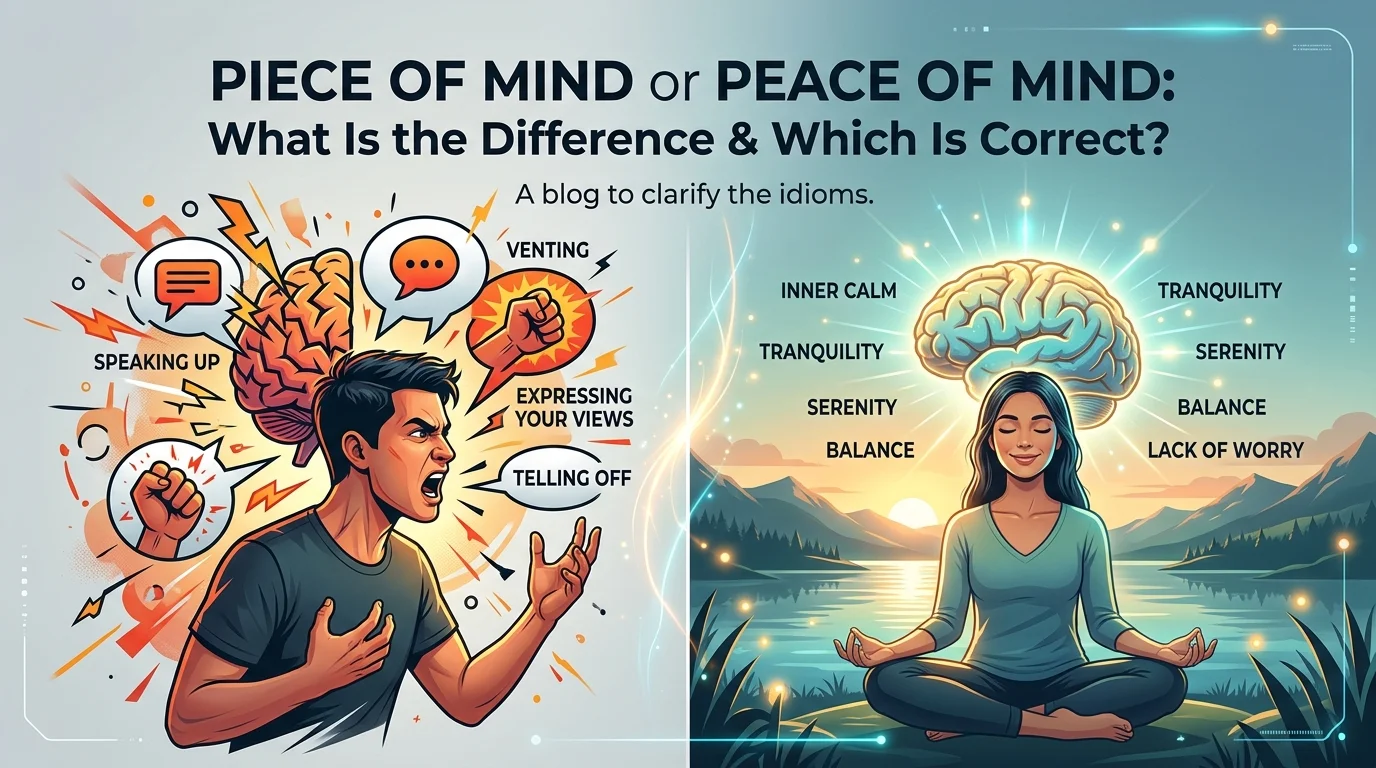

Many English learners confuse “piece of mind” and “peace of mind” because they sound almost identical when spoken. However, only one of them is considered correct in standard English. Understanding the difference matters because using the wrong phrase can completely change your meaning and make your writing look unprofessional.
Comparison Overview
“Piece of mind” and “peace of mind” are commonly confused phrases in English. They are examples of homophones, which are words or phrases that sound alike but have different meanings and spellings.
“Peace of mind” is the correct and widely accepted expression. It refers to a feeling of calmness, reassurance, or freedom from worry. On the other hand, “piece of mind” is usually considered an incorrect spelling mistake unless someone intentionally uses it creatively in rare contexts.
Understanding which phrase to use helps improve grammar, communication, and writing accuracy.
Definition of Piece of Mind
“Piece of mind” is generally not considered a correct standard English expression. It is usually a misspelling or misunderstanding of “peace of mind.”
If taken literally, the phrase could mean “a portion of someone’s thoughts or opinions,” but this meaning is uncommon and rarely used in everyday communication.
Most of the time, when people write “piece of mind,” they actually mean “peace of mind.”
Core Meaning
- Usually an incorrect phrase
- Often caused by pronunciation confusion
- Rarely used literally or creatively
Example
Incorrect:
- Buying insurance gives me piece of mind.
Correct:
- Buying insurance gives me peace of mind.
Definition of Peace of Mind
“Peace of mind” is a correct English idiom that means a feeling of calmness, comfort, security, or freedom from stress and worry.
People use this phrase when something helps them feel safe, relaxed, or mentally comfortable.
Core Meaning
- Mental calmness
- Freedom from worry
- Emotional reassurance
- Confidence and security
Example Sentences
- Locking the door gave her peace of mind.
- Health insurance provides peace of mind during emergencies.
- Parents often want peace of mind about their children’s safety.
Main Differences Between Piece of Mind and Peace of Mind
| Feature | Piece of Mind | Peace of Mind |
| Correct English Phrase | Usually No | Yes |
| Meaning | Rarely meaningful | Calmness and reassurance |
| Common Usage | Mostly a spelling mistake | Very common idiom |
| Grammar Acceptance | Generally incorrect | Grammatically correct |
| Used in Formal Writing | No | Yes |
| Emotional Meaning | None in standard use | Feeling relaxed and secure |
Why People Confuse These Phrases
The confusion happens because “piece” and “peace” are homophones. They sound the same in spoken English but have completely different meanings.
Meaning of “Piece”
“Piece” refers to:
- A part of something
- A section or portion
Examples:
- a piece of cake
- a piece of paper
Meaning of “Peace”
“Peace” refers to:
- Calmness
- Harmony
- Freedom from stress or conflict
Examples:
- world peace
- inner peace
Because the words sound identical, many writers accidentally choose the wrong spelling.
Origins of the Phrase “Peace of Mind”
The expression “peace of mind” has existed for centuries and is connected to emotional comfort and mental calmness. It became especially common in discussions about health, safety, insurance, and personal well-being.
Today, the phrase appears frequently in:
- Advertising
- Business writing
- Everyday conversation
- Mental health discussions
- Financial services
Grammar Guide
How Each Term Is Used in Sentences
Piece of Mind
Usually incorrect:
- Incorrect: This alarm system gives me piece of mind.
Rare literal usage:
- He shared a piece of his mind during the discussion.
Note that “a piece of his mind” is different from “peace of mind.”
Peace of Mind
Correct usage:
- Online backups give businesses peace of mind.
- Parents want peace of mind when traveling.
- Strong passwords provide peace of mind online.
Common Mistakes Learners Make
Here are the most common errors:
- Writing “piece” instead of “peace”
- Assuming both phrases are acceptable
- Confusing “peace of mind” with “piece of my mind”
- Using the incorrect phrase in professional writing
Incorrect:
- The warranty gives customers piece of mind.
Correct:
- The warranty gives customers peace of mind.
Simple Rules to Remember
Use these easy memory tricks:
- “Peace” relates to calmness and relaxation.
- “Peace of mind” means mental calmness.
- If you mean “feeling safe or relaxed,” always use “peace.”
Helpful trick:
- Peace = calm
- Piece = part
Quick Tips for Writing and Speaking
- Always double-check the spelling in professional writing.
- Remember that “peace of mind” is the standard expression.
- Use grammar tools to catch spelling confusion.
- Read the sentence carefully to see if “calmness” fits the meaning.
When to Use Each One
Use “Peace of Mind” When:
- Talking about emotional comfort
- Discussing safety or security
- Describing reduced stress
- Writing formally or professionally
- Referring to reassurance
Examples:
- Travel insurance gives peace of mind.
- Strong cybersecurity provides peace of mind.
- Savings accounts can offer peace of mind.
Use “Piece of Mind” When:
This phrase is rarely appropriate. It may only appear:
- In creative writing
- In wordplay or puns
- When literally discussing a portion of thoughts
Example:
- The artist called the sculpture “A Piece of Mind.”
When NOT to Use Each One
Do Not Use “Piece of Mind” When:
- Referring to calmness
- Talking about reassurance
- Writing business emails
- Creating academic papers
- Using standard English
Incorrect:
- This medicine gives patients piece of mind.
Do Not Use “Peace of Mind” When:
- Referring to an actual physical piece or portion
- Talking about a literal fragment
Incorrect:
- She tore a peace of paper.
Correct:
- She tore a piece of paper.
Which One to Use (Decision Guide)
Ask yourself this question:
“Am I talking about feeling calm, safe, or reassured?”
- If YES → Use “peace of mind”
- If NO → You may need another phrase entirely
Quick decision chart:
| Situation | Correct Phrase |
| Feeling relaxed | Peace of mind |
| Emotional reassurance | Peace of mind |
| Safety and security | Peace of mind |
| Literal part or portion | Piece |
| Standard English writing | Peace of mind |
Real-World Practical Examples
Piece of Mind Examples
These examples show uncommon or literal usage:
- The poet described the essay as a piece of mind.
- The exhibit displayed a creative piece of mind-inspired artwork.
- He presented a small piece of his mind in the debate.
- The phrase appeared intentionally in the song title.
- The writer used “piece of mind” as artistic wordplay.
Peace of Mind Examples
- Installing cameras gave the family peace of mind.
- Cloud backups provide peace of mind for businesses.
- Wearing a helmet gives cyclists peace of mind.
- Good preparation brings peace of mind before exams.
- Health insurance offers peace of mind during emergencies.
- Password protection gives users peace of mind online.
- Parents gained peace of mind after hearing from their children.
- Financial planning can create peace of mind for retirement.
- Antivirus software provides peace of mind for computer users.
- Clear communication often brings peace of mind in relationships.
Self-Assessment (Fill in the Blanks)
- Buying travel insurance gave us ______ during the trip.
- The correct phrase for emotional calmness is ______.
- Parents often seek ______ about their children’s safety.
- “Piece of mind” is usually considered ______.
- A security system can provide ______.
- The phrase connected to relaxation is ______.
- Most grammar experts recommend using ______.
- She wanted ______ before making the decision.
- Good savings can bring financial ______.
- The warranty gave customers ______.
- “Peace” relates to calmness, while “piece” means a ______.
- Using the wrong spelling may confuse your ______.
- Cybersecurity tools help businesses achieve ______.
- The standard English idiom is ______.
- Meditation may help people find ______.
- Learners often confuse these phrases because they ______ alike.
- The alarm system provided complete ______.
- Formal writing should avoid the phrase ______.
- Correct grammar improves reader ______.
- A calm and relaxed mental state is called ______.
Answers
- peace of mind
- peace of mind
- peace of mind
- incorrect
- peace of mind
- peace of mind
- peace of mind
- peace of mind
- peace of mind
- peace of mind
- part
- readers
- peace of mind
- peace of mind
- peace of mind
- sound
- peace of mind
- piece of mind
- trust
- peace of mind
Final Verdict
“Peace of mind” is the correct and widely accepted English phrase. It refers to feelings of calmness, reassurance, comfort, and freedom from worry. “Piece of mind” is usually an incorrect spelling mistake caused by pronunciation confusion between “peace” and “piece.”
If you are writing or speaking about emotional comfort, safety, or reassurance, always choose “peace of mind.” Remembering that “peace” means calmness will help you avoid this common English mistake confidently.
Conclusion About Piece Of Mind or Peace of Mind
Understanding the difference between “piece of mind” and “peace of mind” is important for clear and confident communication. While the two phrases sound exactly alike, only “peace of mind” is correct when talking about calmness, reassurance, or freedom from stress. “Piece of mind” is usually a spelling mistake that can weaken professional writing and create confusion for readers. Learning the correct usage helps improve grammar, writing accuracy, and everyday conversations. Whether you are writing emails, academic content, business documents, or casual messages, choosing the right phrase makes your English sound more natural and polished. A simple way to remember the difference is that “peace” means calmness, while “piece” refers to a part of something. Once you understand this rule, using the correct expression becomes much easier in both speaking and writing.
FAQs
Is “piece of mind” ever correct?
In standard English, “piece of mind” is usually considered incorrect when someone means calmness or reassurance. However, it may occasionally appear in creative writing, titles, or wordplay. In normal communication, “peace of mind” is the correct phrase.
What does “peace of mind” mean?
“Peace of mind” means a feeling of calmness, comfort, security, or freedom from worry. People often use this phrase when something helps them feel mentally relaxed and emotionally reassured in daily life.
Why do people confuse “piece” and “peace”?
People confuse these words because they are homophones, meaning they sound the same when spoken. Even though they share pronunciation, their meanings and spellings are completely different in written English.
Is “peace of mind” an idiom?
Yes, “peace of mind” is a common English idiom. It does not refer to physical peace but instead describes emotional calmness, reassurance, and mental comfort in different situations.
Can I use “piece of mind” in formal writing?
No, using “piece of mind” in formal writing is generally considered a spelling mistake. Professional documents, academic writing, and business communication should always use “peace of mind” when referring to reassurance or calmness.
How can I remember the correct phrase?
A simple memory trick is to connect “peace” with calmness and relaxation. Since “peace of mind” refers to feeling mentally calm, the word “peace” is always the correct choice in this expression.
What is an example of “peace of mind”?
An example sentence is: “Travel insurance gave us peace of mind during our vacation.” In this sentence, the phrase shows reassurance and reduced stress while traveling.
Is “peace of mind” commonly used in business?
Yes, businesses often use “peace of mind” in marketing and customer communication. Insurance companies, security services, and technology brands frequently use the phrase to highlight safety, reliability, and customer confidence.
Does “peace of mind” relate to mental health?
Yes, the phrase is often connected to emotional well-being and mental comfort. People use it when discussing stress reduction, emotional balance, security, and overall psychological reassurance in everyday life.
Are there other phrases similar to “peace of mind”?
Yes, similar expressions include “sense of security,” “mental calmness,” “freedom from worry,” and “inner peace.” These phrases all relate to emotional comfort and reassurance in different contexts.
