
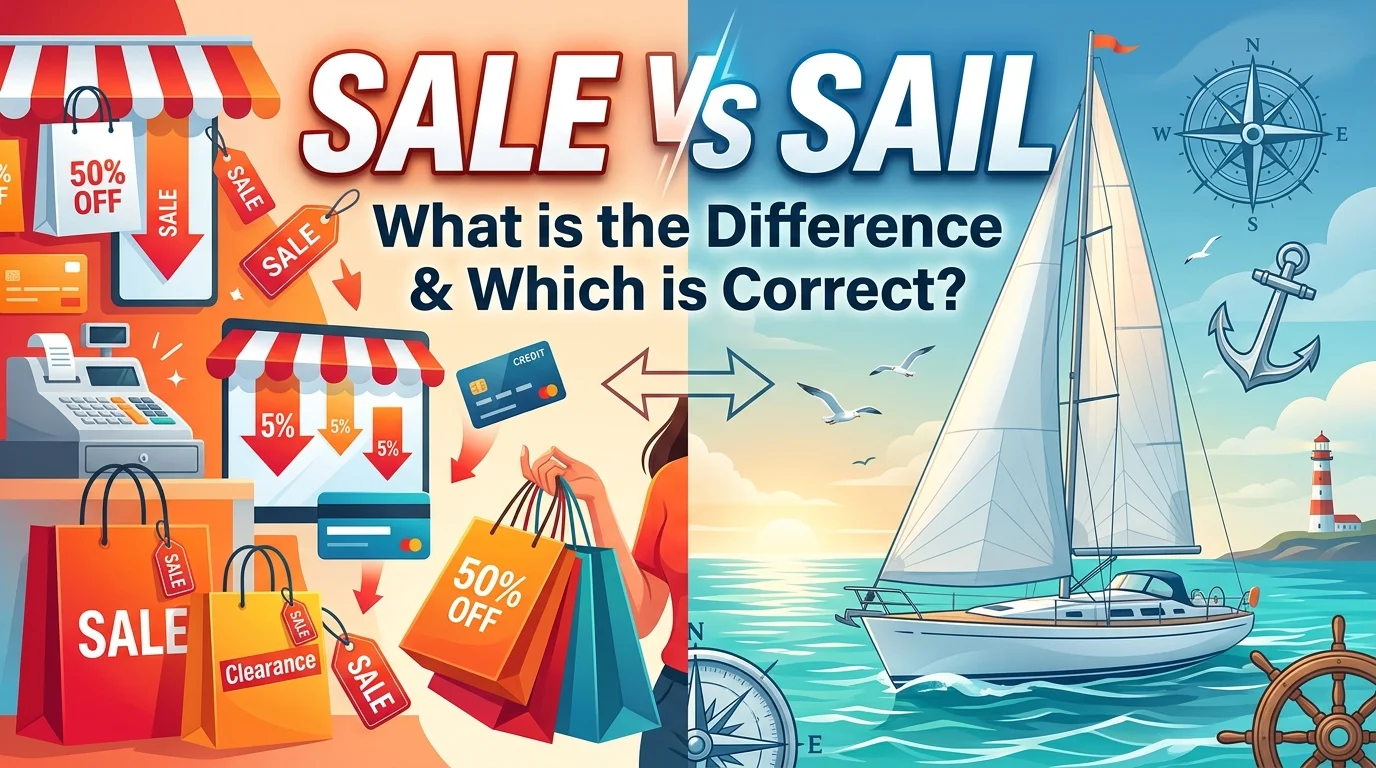

Many English learners confuse “sale” and “sail” because they sound exactly alike but have completely different meanings. These words are homophones, which means they are pronounced the same but spelled differently and used in different contexts. Understanding the difference between “sale” and “sail” helps improve writing, speaking, grammar accuracy, and everyday communication.
Comparison Overview
“Sale” and “sail” are commonly confused English words because they share the same pronunciation. However, their meanings, functions, and usage are completely different.
“Sale” is related to buying, selling, shopping, and business activities. It is commonly used in stores, advertisements, and commerce.
“Sail” is connected to boats, ships, wind movement, and traveling on water. It can be used as both a noun and a verb.
Although they sound identical, using the wrong word can completely change the meaning of a sentence.
| Feature | Sale | Sail |
| Main Meaning | Selling products or services | Traveling on water using a boat or ship |
| Part of Speech | Noun | Noun and Verb |
| Common Context | Shopping, business, marketing | Boats, oceans, travel |
| Example | The store has a big sale. | They sail across the sea. |
| Related Words | Discount, bargain, offer | Boat, ship, voyage |
Definition of Sale
“Sale” is a noun that refers to the exchange of goods or services for money. It is most commonly used in shopping, business, advertising, and commerce.
The word can also describe a special event where products are sold at reduced prices.
Examples of “sale”:
- The clothing store announced a weekend sale.
- The company made thousands of sales this month.
- I bought this laptop during a holiday sale.
The main purpose of the word “sale” is to describe commercial transactions or discounted shopping events.
Definition of Sail
“Sail” can be both a noun and a verb. It is connected to movement on water using wind-powered boats or ships.
As a noun, “sail” refers to the large piece of fabric attached to a boat that catches the wind.
As a verb, “sail” means to travel across water in a boat or ship.
Examples of “sail”:
- The sailors raised the sail.
- We will sail to the island tomorrow.
- The ship sailed smoothly across the ocean.
The word “sail” is mainly used in travel, transportation, boating, and sea-related discussions.
Main Differences Between Sale and Sail
The biggest difference between “sale” and “sail” is their meaning and context.
“Sale” belongs to business and shopping language, while “sail” belongs to boating and water travel vocabulary.
| Aspect | Sale | Sail |
| Meaning | Selling goods or discounts | Traveling on water |
| Usage Area | Commerce and shopping | Boats and ships |
| Word Type | Noun only | Noun and verb |
| Associated With | Money, products, stores | Wind, sea, boats |
| Example Sentence | The shoes are on sale. | They sail every summer. |
Another major difference is grammatical function. “Sale” is only used as a noun, but “sail” can act as both a noun and a verb.
Incorrect example:
- We went on a sale across the ocean. ❌
Correct example:
- We went on a sail across the ocean. ✅
Why These Words Sound Similar
“Sale” and “sail” are homophones in English. Homophones are words that sound the same but have different spellings and meanings.
Examples of other homophones:
- Sea and see
- Right and write
- Flour and flower
Because pronunciation is identical, writers often confuse “sale” and “sail” in fast typing or casual communication.
Common Contexts for Sale
“Sale” frequently appears in:
- Shopping advertisements
- Online stores
- Business reports
- Marketing campaigns
- Retail promotions
Common phrases:
- Flash sale
- Clearance sale
- Final sale
- Garage sale
- For sale
Example:
- The furniture store is having a clearance sale this weekend.
Common Contexts for Sail
“Sail” commonly appears in:
- Travel stories
- Ocean adventures
- Boating activities
- Maritime discussions
- Vacation planning
Common phrases:
- Sail away
- Sail across the ocean
- Set sail
- Sailboat trip
- Smooth sailing
Example:
- The crew prepared to set sail before sunrise.
Grammar Guide
How each term is used in sentences
Sale in Sentences
“Sale” is mainly used as a noun.
Sentence patterns:
- Subject + is/was + on sale
- Noun + sale
- For sale
Examples:
- The phone is on sale today.
- They organized a charity sale.
- That house is for sale.
Sail in Sentences
“Sail” can function as both a noun and a verb.
Sentence patterns:
- Subject + sail/sails/sailed
- Set sail
- Raise the sail
Examples:
- We sail every summer.
- The boat sailed at sunset.
- The captain repaired the sail.
Common mistakes learners make
Many learners accidentally replace one word with the other because of pronunciation similarity.
Common mistakes:
- Incorrect: The store has a huge sail. ❌
- Correct: The store has a huge sale. ✅
- Incorrect: We will sale to Europe tomorrow. ❌
- Correct: We will sail to Europe tomorrow. ✅
Another mistake is forgetting that “sale” cannot be used as a verb.
Incorrect:
- They sale products online. ❌
Correct:
- They sell products online. ✅
Simple rules to remember
Use these simple memory tricks:
- “Sale” contains “ale,” often connected to stores and shopping events.
- “Sail” contains “ai,” like air and wind, which help boats move.
Quick reminder:
- Money or shopping = Sale
- Boats or oceans = Sail
Quick tips for writing and speaking
- Think about the topic first.
- If the sentence discusses business or discounts, use “sale.”
- If the sentence discusses water travel or boats, use “sail.”
- Proofread homophones carefully while writing.
- Practice using both words in different contexts.
When to Use Each One
Use “sale” when:
- Talking about shopping
- Discussing discounts
- Mentioning business transactions
- Advertising products
- Referring to commercial exchanges
Examples:
- The store announced a holiday sale.
- Car sales increased this year.
Use “sail” when:
- Talking about boats or ships
- Describing ocean travel
- Referring to water journeys
- Discussing sailing sports
- Mentioning ship movement
Examples:
- They sail around the world.
- The sail caught the wind.
When NOT to Use Each One
Do not use “sale” when discussing:
- Boats
- Oceans
- Water travel
- Ships
- Wind-powered movement
Incorrect:
- The ship began its sale. ❌
Correct:
- The ship began its sail. ✅
Do not use “sail” when discussing:
- Discounts
- Shopping promotions
- Business transactions
- Product marketing
Incorrect:
- The supermarket started a weekend sail. ❌
Correct:
- The supermarket started a weekend sale. ✅
Which One to Use (Decision Guide)
Use this quick guide to choose the correct word:
Ask yourself:
- Is the topic related to shopping or business?
- Yes → Use “sale”
- Is the topic related to boats, oceans, or travel on water?
- Yes → Use “sail”
- Is the sentence about discounts or products?
- Use “sale”
- Is the sentence about ships or wind?
- Use “sail”
| Situation | Correct Word |
| Store discount | Sale |
| Boat trip | Sail |
| Online shopping | Sale |
| Ocean travel | Sail |
| Product advertisement | Sale |
| Yacht movement | Sail |
Real-World Practical Examples
Sale Examples
- The electronics store started a massive summer sale.
- Our company recorded strong sales this quarter.
- She bought the dress during a holiday sale.
- The old house is now for sale.
- Online sales increased after the advertisement campaign.
Sail Examples
- They sail across the lake every weekend.
- The sail moved strongly in the wind.
- We plan to sail to another island tomorrow.
- The captain taught students how to sail safely.
- The ship sailed through the storm carefully.
Self-Assessment (Fill in the Blanks)
- The supermarket announced a weekend ______.
- We will ______ across the river tomorrow.
- The boat’s ______ was damaged during the storm.
- The shoes are on ______ today.
- They love to ______ during summer vacations.
- The company increased its annual ______.
- The captain prepared to ______ at sunrise.
- The car is officially for ______.
- Fishermen often ______ early in the morning.
- The department store organized a holiday ______.
- The ship raised its large ______.
- We watched the boats ______ across the ocean.
- The online ______ attracted many customers.
- They learned how to ______ in sailing school.
- The laptop went on ______ last night.
- The crew repaired the broken ______.
- Our business made its highest ______ this year.
- The tourists will ______ around the island.
- The furniture ______ ends tomorrow.
- The yacht began to ______ smoothly.
Answers
- sale
- sail
- sail
- sale
- sail
- sales
- sail
- sale
- sail
- sale
- sail
- sail
- sale
- sail
- sale
- sail
- sales
- sail
- sale
- sail
Final Verdict
“Sale” and “sail” may sound identical, but they have completely different meanings and uses in English. “Sale” is connected to shopping, discounts, and business transactions, while “sail” relates to boats, ships, and traveling on water. The easiest way to choose the correct word is to think about the context of the sentence. If money, stores, or products are involved, use “sale.” If oceans, boats, or wind-powered travel are involved, use “sail.” Understanding this difference improves grammar accuracy, writing clarity, and everyday communication skills.
Conclusion About Sale Vs Sail
Understanding the difference between “sale” and “sail” is important for improving both written and spoken English. Although these two words sound exactly alike, they belong to completely different contexts. “Sale” is connected to shopping, discounts, and business transactions, while “sail” relates to boats, ships, and traveling across water. Learning how to use them correctly helps avoid common grammar mistakes and makes communication clearer and more professional. The easiest way to remember the difference is to focus on the topic of the sentence. If the discussion involves stores, products, or money, “sale” is the correct choice. If the sentence talks about oceans, wind, or boats, “sail” is the right word. With regular practice, examples, and careful proofreading, you can confidently use both words correctly in daily conversations, academic writing, business communication, and professional English.
FAQs
What is the main difference between sale and sail?
“Sale” refers to selling products, discounts, or business transactions, while “sail” relates to boats, ships, or traveling on water. Even though both words sound the same, their meanings and usage are completely different. Context helps determine which word should be used in a sentence.
Are sale and sail homophones?
Yes, “sale” and “sail” are homophones. This means they are pronounced the same way but have different spellings and meanings. Homophones are common in English and often confuse learners during writing and speaking exercises.
Can sale be used as a verb?
No, “sale” is generally used only as a noun. The verb form connected to “sale” is “sell.” For example, you can say “They sell books online,” but not “They sale books online.”
Can sail be both a noun and a verb?
Yes, “sail” can function as both a noun and a verb. As a noun, it refers to the fabric used on boats. As a verb, it means traveling across water using a boat or ship.
How can I remember the difference between sale and sail?
A simple way to remember is by connecting “sale” with shopping and money, while “sail” relates to water and boats. Thinking about the sentence topic makes choosing the correct word much easier.
Is “for sail” correct English?
No, “for sail” is incorrect in most situations. The correct phrase is “for sale” when talking about something available to buy. “Sail” should only be used in boating or water-travel contexts.
Why do learners confuse sale and sail?
Learners often confuse these words because they sound exactly the same when spoken. Since English contains many homophones, spelling mistakes commonly happen during fast writing or casual communication.
What are common phrases using sale?
Common phrases include “garage sale,” “flash sale,” “clearance sale,” “for sale,” and “holiday sale.” These phrases are widely used in shopping, retail advertisements, and business communication.
What are common phrases using sail?
Popular phrases include “set sail,” “smooth sailing,” “sail away,” and “sail across the ocean.” These expressions are commonly used in travel, boating, and adventure-related conversations.
Which word should I use in business writing?
In business writing, “sale” is usually the correct choice because it relates to products, customers, transactions, and revenue. “Sail” would only be appropriate if the topic specifically involves ships, boats, or water travel.
