
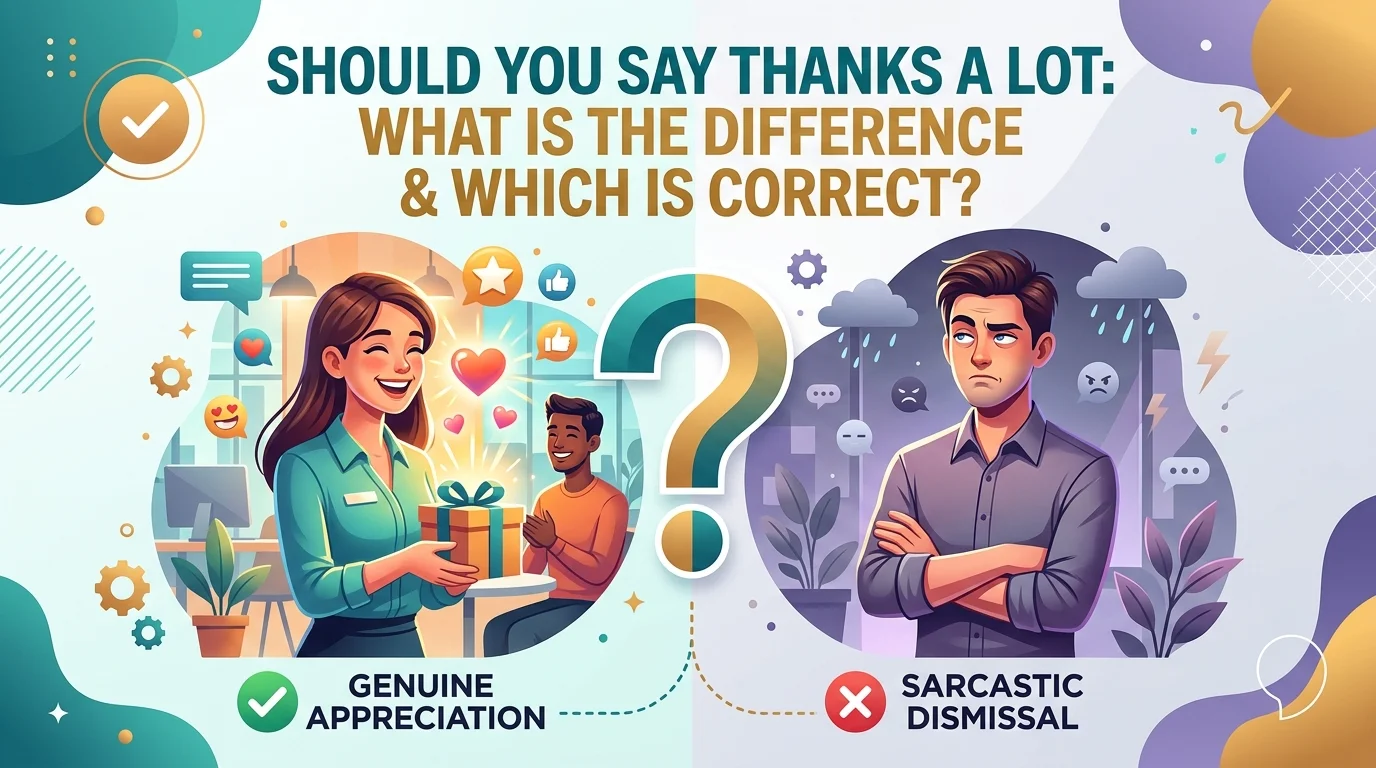

Many English learners wonder whether “Should you say thanks a lot” is a correct phrase and how it compares with other expressions like “thank you very much” or “thanks a lot.” These phrases may seem similar, but they carry different tones, levels of politeness, and emotional meanings. Understanding the difference helps you speak and write English more naturally and confidently.
Comparison Overview
The phrase “Should you say thanks a lot” is different from simply saying “thanks a lot.” One is a question or suggestion about expressing gratitude, while the other is the actual expression of gratitude itself. English speakers use these phrases in different situations depending on tone, grammar, and context.
Here is a quick comparison table:
| Phrase | Type | Main Purpose | Common Usage |
| Should you say thanks a lot | Question/Suggestion | Asking whether gratitude should be expressed | Advice, learning, grammar discussions |
| Thanks a lot | Expression | Showing gratitude | Casual conversations |
| Thank you very much | Formal expression | Showing polite gratitude | Professional and formal settings |
Definition of “Should You Say Thanks A Lot”
“Should you say thanks a lot” is a question phrase. It asks whether someone ought to express gratitude using the phrase “thanks a lot.”
This phrase is often used in:
- Grammar discussions
- Language learning
- Advice articles
- Social communication guidance
Example:
- Should you say thanks a lot after receiving help from a coworker?
The phrase itself does not directly express gratitude. Instead, it discusses whether gratitude should be expressed.
Definition of “Thanks A Lot”
“Thanks a lot” is a common English expression used to thank someone warmly in casual situations.
It usually sounds:
- Friendly
- Informal
- Natural in conversation
Examples:
- Thanks a lot for helping me move.
- Thanks a lot for your advice.
However, tone matters. Sometimes “thanks a lot” can sound sarcastic if spoken angrily.
Example:
- Oh, thanks a lot. Now I missed the bus.
Definition of “Thank You Very Much”
“Thank you very much” is a more formal and polite expression of gratitude.
People often use it in:
- Professional communication
- Customer service
- Formal conversations
- Respectful situations
Examples:
- Thank you very much for your support.
- Thank you very much for attending the meeting.
This phrase usually sounds more sincere and respectful than “thanks a lot.”
Main Differences Between “Should You Say Thanks A Lot,” “Thanks A Lot,” and “Thank You Very Much”
The biggest difference is grammatical function.
| Phrase | Function | Tone | Formality |
| Should you say thanks a lot | Question or suggestion | Neutral | Neutral |
| Thanks a lot | Expression of gratitude | Casual | Informal |
| Thank you very much | Expression of gratitude | Polite | Formal |
Another important difference is usage context.
- “Should you say thanks a lot” discusses language choices.
- “Thanks a lot” is used directly in conversation.
- “Thank you very much” is more suitable for professional or respectful situations.
Tone and Emotional Meaning
Tone changes how these phrases are understood.
“Thanks a lot”
This phrase can sound:
- Friendly
- Warm
- Sarcastic
Examples:
- Friendly: Thanks a lot for your gift.
- Sarcastic: Thanks a lot for ruining the surprise.
“Thank You Very Much”
This phrase almost always sounds polite and respectful.
Example:
- Thank you very much for your patience.
“Should You Say Thanks A Lot”
This phrase is neutral because it asks a question rather than expressing emotion.
Example:
- Should you say thanks a lot in professional emails?
Formal vs Informal Usage
| Phrase | Formality Level |
| Thanks a lot | Informal |
| Thank you very much | Formal |
| Should you say thanks a lot | Neutral |
Use “thanks a lot” with:
- Friends
- Family
- Coworkers in casual settings
Use “thank you very much” with:
- Teachers
- Clients
- Managers
- Formal audiences
Grammar Guide
How Each Term Is Used in Sentences
“Should You Say Thanks A Lot”
Pattern:
- Should + subject + say + phrase
Examples:
- Should you say thanks a lot after receiving a compliment?
- Should students say thanks a lot to teachers?
“Thanks A Lot”
Pattern:
- Thanks a lot + for + noun/verb
Examples:
- Thanks a lot for your support.
- Thanks a lot for coming.
“Thank You Very Much”
Pattern:
- Thank you very much + for + noun/verb
Examples:
- Thank you very much for your assistance.
- Thank you very much for explaining the lesson.
Common Mistakes Learners Make
Many learners confuse formality levels.
Incorrect:
- Thanks a lot, Sir, for approving the official contract.
Better:
- Thank you very much, Sir, for approving the official contract.
Another common mistake is misunderstanding sarcasm.
Example:
- “Thanks a lot” may sound rude if spoken with frustration.
Learners also sometimes forget that “Should you say thanks a lot” is a question, not a gratitude phrase.
Simple Rules to Remember
- Use “thanks a lot” for casual situations.
- Use “thank you very much” for formal situations.
- Use “should you say thanks a lot” when discussing language or asking for advice.
Quick Tips for Writing and Speaking
- Choose tone carefully.
- Avoid sarcasm in professional communication.
- Use formal gratitude in business emails.
- Use casual gratitude with friends and family.
- Practice natural pronunciation and intonation.
When to Use Each One
Use “Should You Say Thanks A Lot” When:
- Asking grammar questions
- Discussing communication etiquette
- Giving language advice
Use “Thanks A Lot” When:
- Talking casually
- Thanking friends
- Showing relaxed appreciation
Use “Thank You Very Much” When:
- Writing professional emails
- Speaking respectfully
- Addressing formal audiences
When NOT to Use Each One
Avoid “Thanks A Lot” When:
- Speaking formally
- Writing academic papers
- Addressing important clients
Avoid “Thank You Very Much” When:
- You want a very casual tone among close friends
Avoid “Should You Say Thanks A Lot” When:
- You simply want to thank someone directly
Incorrect:
- Should you say thanks a lot for your help?
Correct:
- Thanks a lot for your help.
Which One to Use (Decision Guide)
Use this quick guide:
| Situation | Best Choice |
| Casual conversation | Thanks a lot |
| Formal meeting | Thank you very much |
| Grammar discussion | Should you say thanks a lot |
| Friendly text message | Thanks a lot |
| Professional email | Thank you very much |
If you are unsure, “thank you very much” is usually the safest and most polite option.
Real-World Practical Examples
“Should You Say Thanks A Lot” Examples
- Should you say thanks a lot after receiving career advice?
- Should students say thanks a lot to professors?
- Should you say thanks a lot in customer service chats?
- Should employees say thanks a lot during formal presentations?
- Should writers say thanks a lot in academic acknowledgments?
“Thanks A Lot” Examples
- Thanks a lot for fixing my laptop.
- Thanks a lot for helping with homework.
- Thanks a lot for driving me home.
- Thanks a lot for the birthday gift.
- Thanks a lot for sharing the recipe.
“Thank You Very Much” Examples
- Thank you very much for attending the conference.
- Thank you very much for your cooperation.
- Thank you very much for reviewing the report.
- Thank you very much for your contribution to the project.
- Thank you very much for your patience during the interview.
Self-Assessment (Fill in the Blanks)
- I will use ______ when speaking to my manager politely.
- The correct word is ______ because the situation is casual.
- I should say ______ during a professional presentation.
- The correct phrase is ______ because I am asking a grammar question.
- Friends usually say ______ in relaxed conversations.
- I will use ______ when writing a business email.
- The correct phrase is ______ because it discusses language usage.
- Students may say ______ after receiving help from classmates.
- The correct answer is ______ because the tone is formal.
- I should use ______ when talking respectfully to a customer.
- The phrase ______ can sometimes sound sarcastic.
- I will choose ______ in a formal interview.
- The correct phrase is ______ because it asks for advice.
- Casual text messages often include ______.
- The correct answer is ______ because it directly expresses gratitude formally.
- I should not use ______ in very formal writing.
- The phrase ______ is mainly used in grammar discussions.
- In daily conversation, people often say ______.
- The correct phrase is ______ because it sounds more respectful.
- I should use ______ when thanking a teacher formally.
Answers
- thank you very much
- thanks a lot
- thank you very much
- should you say thanks a lot
- thanks a lot
- thank you very much
- should you say thanks a lot
- thanks a lot
- thank you very much
- thank you very much
- thanks a lot
- thank you very much
- should you say thanks a lot
- thanks a lot
- thank you very much
- thanks a lot
- should you say thanks a lot
- thanks a lot
- thank you very much
- thank you very much
Final Verdict
“Thanks a lot,” “thank you very much,” and “should you say thanks a lot” serve different purposes in English. “Thanks a lot” is informal and conversational, while “thank you very much” is more formal and respectful. “Should you say thanks a lot” is not a gratitude expression at all but a question used in grammar or etiquette discussions. By understanding tone, context, and grammar, you can confidently choose the right phrase for every situation.
Conclusion About Should You Say Thanks A Lot
Understanding the difference between “should you say thanks a lot,” “thanks a lot,” and “thank you very much” can make your English sound more natural, polite, and confident. While these expressions are all connected to gratitude, they serve different purposes depending on grammar, tone, and context. “Thanks a lot” works best in casual conversations, while “thank you very much” is more formal and respectful. On the other hand, “should you say thanks a lot” is mainly used when discussing language usage or asking for advice about polite communication. Learning these small differences helps improve both spoken and written English in everyday life, business, education, and social settings. By paying attention to formality, tone, and audience, you can choose the right expression with ease and communicate appreciation clearly in every situation.
FAQs
Is “thanks a lot” always polite?
No, “thanks a lot” is not always polite. In most situations, it sounds friendly and appreciative. However, if spoken with frustration or sarcasm, it can sound rude or annoyed. Tone of voice and context are very important when using this expression in conversation.
Is “thank you very much” more formal than “thanks a lot”?
Yes, “thank you very much” is generally more formal and respectful than “thanks a lot.” It is commonly used in professional communication, customer service, interviews, and polite conversations where extra respect or appreciation is needed.
Can I use “thanks a lot” in business emails?
You can use “thanks a lot” in informal business emails with coworkers you know well. However, in professional or formal emails, “thank you very much” or simply “thank you” is usually a better and safer choice.
Why does “thanks a lot” sometimes sound sarcastic?
“Thanks a lot” may sound sarcastic when someone says it after a problem or inconvenience. The words themselves are positive, but the speaker’s tone and the situation can completely change the meaning into frustration or criticism.
What does “should you say thanks a lot” mean?
The phrase “should you say thanks a lot” is a question used to discuss language, manners, or grammar. It asks whether using the phrase “thanks a lot” is appropriate in a specific situation or context.
Which phrase is better for formal speaking?
“Thank you very much” is better for formal speaking because it sounds respectful, polished, and professional. It is commonly used in speeches, presentations, interviews, customer interactions, and academic settings where polite language is important.
Is “thanks a lot” common in everyday English?
Yes, “thanks a lot” is very common in daily English conversations. Native speakers often use it with friends, family members, classmates, and coworkers during casual interactions to express gratitude naturally and comfortably.
Can English learners use both expressions?
Yes, English learners can use both expressions. The important thing is understanding the level of formality. “Thanks a lot” fits relaxed situations, while “thank you very much” is better for respectful or professional communication.
Is “thank you very much” too formal for friends?
Sometimes it can sound slightly formal with close friends, especially in casual chats. However, people still use it sincerely when expressing deep gratitude or appreciation. In relaxed conversations, “thanks a lot” often sounds more natural.
How can I remember when to use each phrase?
A simple rule is to match the phrase to the situation. Use “thanks a lot” for casual communication and “thank you very much” for formal or respectful situations. Use “should you say thanks a lot” only when asking or discussing grammar and etiquette.
