
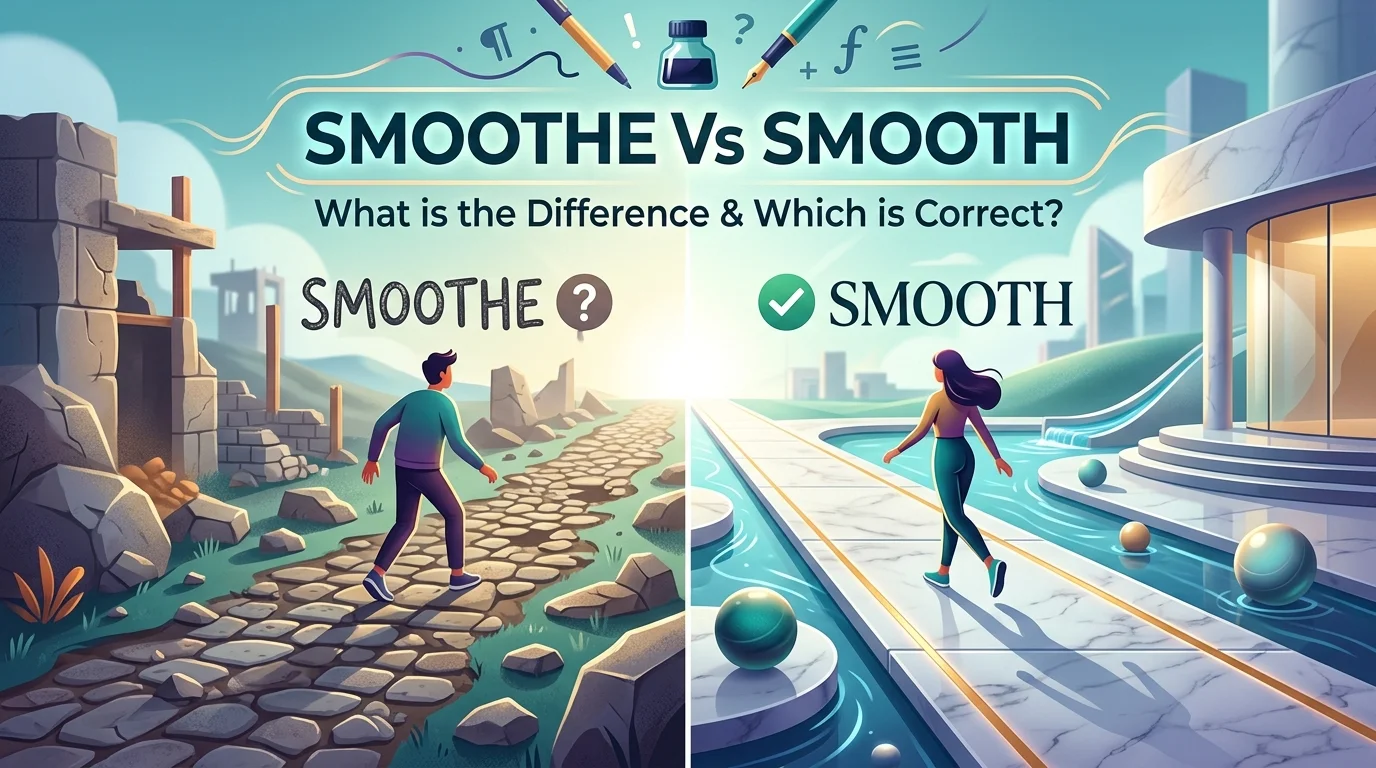

Many English learners get confused between “smoothe” and “smooth” because the words look almost identical. However, only one is commonly accepted in modern English grammar and writing. Understanding the difference matters because using the wrong spelling can make your writing appear incorrect or outdated. This guide explains their meanings, grammar, usage, examples, and the correct choice in everyday communication.
Comparison Overview
“Smooth” is the standard and correct English word used as an adjective, verb, and noun in modern grammar. It describes something even, soft, polished, or flowing without difficulty.
“Smoothe,” on the other hand, is considered an old or rare spelling. In modern English, it is generally viewed as incorrect unless used in historical texts, poetry, or archaic writing styles.
The confusion happens because many verbs in English end with “e,” causing some people to mistakenly add an extra “e” to “smooth.”
| Feature | Smooth | Smoothe |
| Modern English Usage | Correct | Rare/Outdated |
| Common in Writing | Yes | No |
| Accepted Grammar | Yes | Usually No |
| Dictionary Status | Standard word | Archaic variant |
| Used in Daily Conversation | Frequently | Almost never |
Definition of Smooth
“Smooth” is a standard English word that can function as an adjective, verb, or noun depending on the sentence.
As an adjective, it describes something even, flat, soft, polished, or flowing easily.
As a verb, it means to make something even or less rough.
Examples:
- The table has a smooth surface.
- She gave a smooth presentation.
- He smoothed the paper with his hand.
The word is widely used in education, business, technology, beauty, music, and everyday conversation.
Definition of Smoothe
“Smoothe” is an archaic or historical spelling variation of “smooth.” It appeared in older forms of English but is rarely used today.
In modern grammar and professional writing, “smoothe” is usually considered incorrect. Most spell checkers and grammar tools flag it as a mistake.
You may occasionally see “smoothe” in:
- Old literature
- Historical documents
- Poetic writing
- Stylized brand names
For normal communication, essays, emails, and professional writing, “smooth” is the correct choice.
Main Differences Between Smoothe and Smooth
The biggest difference is correctness in modern English.
Spelling Difference
- “Smooth” is the accepted spelling.
- “Smoothe” is outdated and rarely accepted.
Usage Difference
- “Smooth” is used in everyday communication.
- “Smoothe” is mostly avoided in modern writing.
Grammar Difference
- “Smooth” works correctly as an adjective and verb.
- “Smoothe” does not follow standard modern grammar conventions.
Professional Writing Difference
- “Smooth” appears in books, websites, schools, and business communication.
- “Smoothe” may look like a spelling mistake in professional settings.
Pronunciation
Interestingly, both words are generally pronounced the same way:
/smuːð/
Why People Confuse Smoothe and Smooth
Many learners assume “smoothe” must be correct because English verbs often end in “e.”
Examples:
- Bathe
- Breathe
- Soothe
Because of this pattern, people mistakenly believe “smooth” should also become “smoothe.”
However, English spelling does not always follow predictable rules, and “smooth” remains the correct modern form.
Is “Smoothe” Ever Correct?
In rare situations, yes.
You might encounter “smoothe” in:
- Historical literature
- Shakespearean-style writing
- Old dictionaries
- Artistic or poetic expressions
Example:
- “He did smoothe the cloth with care.”
However, this style sounds old-fashioned today.
For modern English:
- Use “smooth”
- Avoid “smoothe”
Grammar Guide
How each term is used in sentences
Smooth in Sentences
As an adjective:
- The road is smooth.
As a verb:
- Please smooth the wrinkles from the paper.
As a descriptive expression:
- She has a smooth speaking style.
Smoothe in Sentences
Rare archaic usage:
- He did smoothe the fabric carefully.
Modern writing usually avoids this spelling.
Common mistakes learners make
Adding an unnecessary “e”
Incorrect:
- Your writing is smoothe.
Correct:
- Your writing is smooth.
Using “smoothe” in formal writing
Incorrect:
- The software provides a smoothe experience.
Correct:
- The software provides a smooth experience.
Assuming both are equally accepted
They are not equally accepted in modern English.
Simple rules to remember
- “Smooth” is the modern correct word.
- “Smoothe” is outdated.
- If writing for school, business, or online content, always choose “smooth.”
Easy memory tip:
“Smooth keeps it simple.”
Quick tips for writing and speaking
- Use “smooth” in all modern situations.
- Avoid “smoothe” unless discussing historical English.
- Check spelling carefully in professional documents.
- Remember that spell checkers usually reject “smoothe.”
When to Use Each One
Use “Smooth” When:
- Describing texture
- Talking about easy movement
- Discussing communication style
- Writing professional documents
- Describing software or technology
- Talking about calm conversations
Examples:
- The app runs smoothly.
- She has smooth skin.
- The transition was smooth.
Use “Smoothe” When:
- Quoting historical texts
- Writing archaic poetry
- Referencing old English styles
These situations are uncommon.
When NOT to Use Each One
Do NOT Use “Smooth” Incorrectly
Avoid using it where another adjective is more accurate.
Incorrect:
- The math problem was smooth.
Better:
- The math problem was simple.
Do NOT Use “Smoothe” in Modern English
Avoid it in:
- Essays
- Emails
- Reports
- Academic writing
- Business communication
- Website content
Incorrect:
- We provide smoothe customer service.
Correct:
- We provide smooth customer service.
Which One to Use (Decision Guide)
Use this simple guide:
| Situation | Correct Choice |
| Modern English writing | Smooth |
| School assignments | Smooth |
| Professional emails | Smooth |
| Casual conversation | Smooth |
| Historical or poetic writing | Smoothe (rarely) |
| SEO content | Smooth |
If you are unsure, always choose “smooth.”
Real-World Practical Examples
Smooth Examples
- The company ensured a smooth onboarding process for new employees.
- Her smooth voice made the presentation enjoyable.
- The smartphone screen feels smooth to the touch.
- Scientists designed a smooth airflow system for the experiment.
- The teacher explained the lesson in a smooth and clear manner.
Smoothe Examples
- The ancient manuscript used the spelling “smoothe.”
- The poet chose “smoothe” to imitate old English.
- Historians discovered the word “smoothe” in medieval texts.
- Some archaic translations still contain “smoothe.”
- The writer intentionally used “smoothe” for stylistic effect.
Self-Assessment (Fill in the Blanks)
- The correct modern spelling is ______.
- The table has a very ______ surface.
- Most writers avoid using ______ in modern English.
- The presentation went very ______.
- He tried to ______ the wrinkles from the paper.
- “Smoothe” is considered an ______ spelling.
- The software provides a ______ user experience.
- Teachers usually recommend using ______ in essays.
- The old poem used the spelling ______.
- The road became ______ after repairs.
- She has a ______ speaking style.
- Modern dictionaries prefer the word ______.
- Historical texts may contain the word ______.
- The transition between scenes was ______.
- Spell checkers often flag ______ as incorrect.
- We need a ______ workflow in the office.
- The baby’s skin feels ______.
- The writer used ______ to sound old-fashioned.
- Professional writing should normally use ______.
- The correct word in modern grammar is ______.
Answers
- Smooth
- Smooth
- Smoothe
- Smoothly
- Smooth
- Archaic
- Smooth
- Smooth
- Smoothe
- Smooth
- Smooth
- Smooth
- Smoothe
- Smooth
- Smoothe
- Smooth
- Smooth
- Smoothe
- Smooth
- Smooth
Final Verdict
Between “smoothe” and “smooth,” the correct and widely accepted modern English word is “smooth.” It is used in everyday conversation, academic writing, business communication, and professional content. “Smoothe” is an outdated spelling that mainly appears in historical or poetic contexts. Although both words may sound the same, they are not equally correct in modern usage. If your goal is clear, professional, and grammatically accurate writing, you should almost always choose “smooth.” Remembering this simple distinction will help improve your spelling, grammar confidence, and overall communication skills in both writing and speaking
Conclusion About Smoothe Vs Smooth
Understanding the difference between “smoothe” and “smooth” can help you avoid common spelling mistakes and write with more confidence. While the two words may look similar and even sound the same, only “smooth” is considered correct in modern English. It is the standard spelling used in schools, business writing, conversations, websites, and professional communication. “Smoothe” mainly appears in historical or poetic contexts and is rarely accepted in everyday writing today. By learning when and how to use “smooth” correctly, you can improve both your grammar and your overall writing clarity. Whether you are writing an email, creating content, studying English, or simply trying to communicate more effectively, choosing the right word makes a big difference. Remember this simple rule: in modern English, “smooth” is almost always the correct and safest choice.
FAQs
Is smooth the correct spelling?
Yes, “smooth” is the correct spelling in modern English. It is widely accepted in dictionaries, schools, professional writing, and everyday communication. The word can describe something soft, polished, even, or flowing easily. Most grammar tools and spell checkers recognize “smooth” as the standard form.
Is smoothe a real word?
Yes, “smoothe” is technically a real word, but it is considered archaic or outdated. It appeared in older forms of English and may still appear in historical texts or poetry. However, modern English writers rarely use it, and it is generally viewed as incorrect today.
Why do people confuse smoothe and smooth?
People often confuse them because many English verbs end with the letter “e,” such as “breathe” or “soothe.” This pattern causes some learners to assume “smooth” should also end with “e.” However, English spelling rules are not always consistent, and “smooth” remains the correct modern spelling.
Can smooth be used as a verb?
Yes, “smooth” can function as a verb. When used this way, it means to make something flat, even, or less rough. For example, you can “smooth” wrinkles from fabric or “smooth” a rough surface before painting or polishing it.
Is smoothe acceptable in academic writing?
No, “smoothe” is not considered acceptable in modern academic writing. Teachers, editors, and grammar checkers usually mark it as incorrect. Academic essays, reports, and professional documents should use “smooth” instead to maintain proper grammar and spelling standards.
What does smooth mean in everyday English?
In everyday English, “smooth” usually describes something soft, even, polished, calm, or easy. It can refer to physical surfaces, communication styles, movements, or experiences. For example, people often describe roads, skin, music, conversations, and software as “smooth.”
How do you remember the correct spelling?
A simple way to remember the correct spelling is to think of “smooth” as the shorter and simpler form. Since modern English prefers simpler spellings in many cases, “smooth” is the standard choice. Avoid adding an unnecessary “e” at the end of the word.
Is smoothe ever used today?
“Smoothe” is rarely used today except in historical writing, poetry, or stylistic works that imitate old English. Some authors may intentionally use it for artistic reasons, but it is uncommon in modern books, articles, emails, or online content.
Which spelling should content writers use?
Content writers should always use “smooth” in blogs, articles, marketing content, websites, and professional communication. Using “smoothe” can confuse readers and may appear as a spelling error. “Smooth” is the safer and grammatically correct choice for modern audiences.
Are smooth and smoothe pronounced differently?
No, they are generally pronounced the same way. Both are spoken as “smoo-th.” Even though the spellings differ slightly, the pronunciation remains nearly identical. This similarity in sound is another reason why many English learners accidentally confuse the two words.
.
