
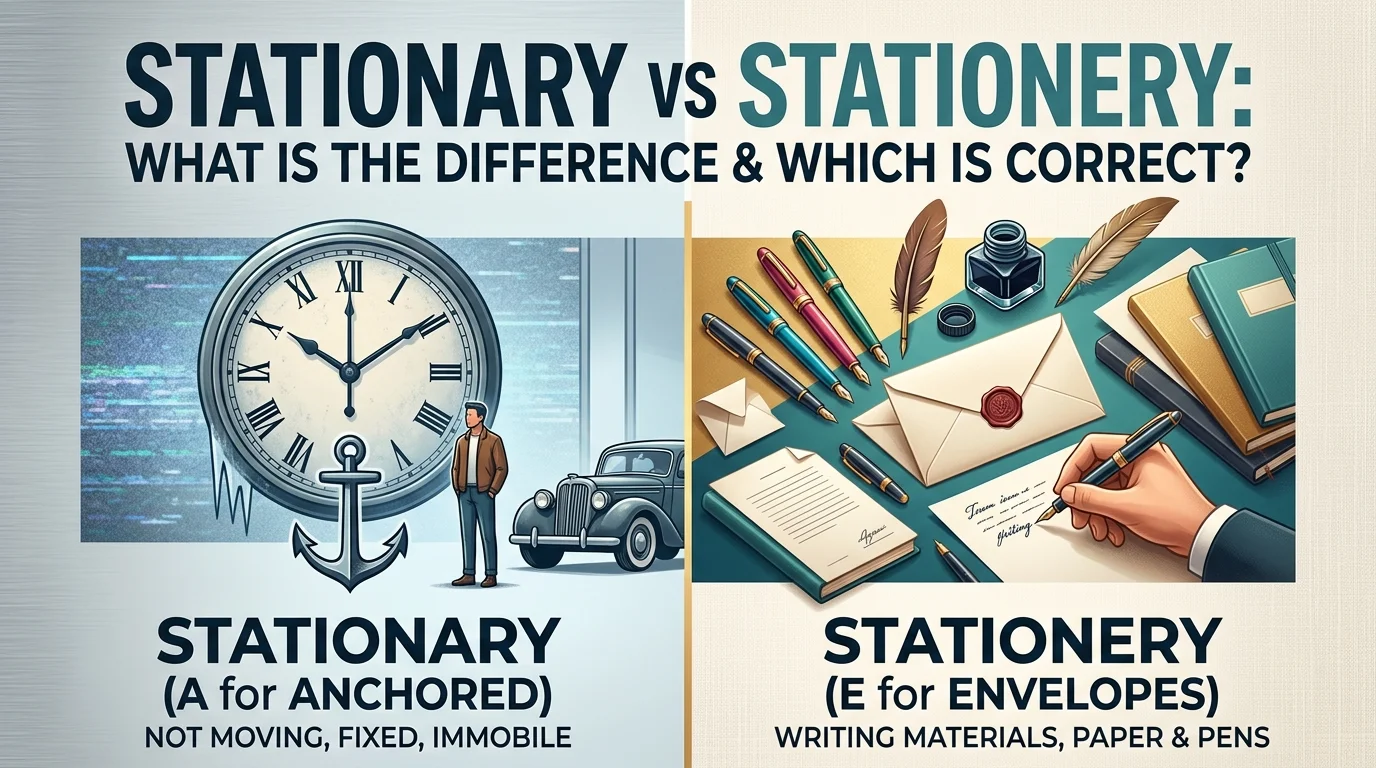

Many English learners confuse stationary and stationery because they sound exactly alike. Despite their similar pronunciation, these two words have completely different meanings. Understanding the difference is important for clear communication, correct grammar, and professional writing. This guide explains both terms in detail, shows how to use them correctly, and helps you avoid common mistakes.
Comparison Overview
Stationary and stationery are commonly confused words known as homophones. They sound the same but have different spellings and meanings.
| Term | Meaning | Part of Speech | Common Usage |
| Stationary | Not moving; fixed in one place | Adjective | Vehicles, objects, people |
| Stationery | Writing materials and office supplies | Noun | Paper, envelopes, notebooks, pens |
The key difference is simple: stationary describes something that does not move, while stationery refers to writing and office materials.
Definition of Stationary
Stationary is an adjective that describes something that is not moving or remains in one place.
It is often used when talking about vehicles, objects, people, or positions that stay fixed.
Key Characteristics of Stationary
- Means unmoving or fixed
- Describes a condition or state
- Functions as an adjective
- Commonly used in transportation, science, and daily conversations
Examples
- The car remained stationary at the traffic light.
- The boat was stationary in the harbor.
- The security camera monitored a stationary object.
- He stood stationary while waiting for instructions.
- The train remained stationary due to technical issues.
Definition of Stationery
Stationery is a noun that refers to writing materials and office supplies used for correspondence, note-taking, and documentation.
It includes items such as paper, envelopes, notebooks, pens, and business letterheads.
Key Characteristics of Stationery
- Refers to office and writing supplies
- Functions as a noun
- Used in schools, offices, and businesses
- Relates to written communication
Examples
- She purchased new stationery for school.
- The company ordered branded stationery.
- The stationery store sells notebooks and envelopes.
- He wrote the letter on elegant stationery.
- Our office needs more stationery supplies.
Main Differences Between Stationary and Stationery
Although they sound identical, their meanings and grammatical functions are completely different.
| Feature | Stationary | Stationery |
| Meaning | Not moving | Writing materials |
| Word Type | Adjective | Noun |
| Refers To | Position or movement | Office supplies |
| Usage Context | Transportation, science, movement | Schools, offices, writing |
| Example | The bike is stationary. | I bought new stationery. |
Meaning Difference
- Stationary relates to movement or the lack of movement.
- Stationery relates to paper products and office supplies.
Function Difference
- Stationary describes a noun.
- Stationery names a thing.
Context Difference
- Use stationary when discussing location or motion.
- Use stationery when discussing writing tools or office materials.
Why People Confuse Stationary and Stationery
The confusion occurs because:
- Both words are pronounced the same way.
- Their spellings differ by only one letter.
- Both are common in formal writing.
- Many learners remember the pronunciation but not the spelling.
Fortunately, a simple memory trick can solve the problem.
Comparison Table
| Question | Correct Word |
| Something is not moving | Stationary |
| Office supplies are needed | Stationery |
| A parked vehicle | Stationary |
| Letter-writing materials | Stationery |
| Fixed position | Stationary |
| Envelopes and paper | Stationery |
Grammar Guide
How each term is used in sentences
Stationary Sentence Patterns
- Subject + be verb + stationary
- Stationary + noun
Examples:
- The vehicle is stationary.
- The stationary machine requires inspection.
- The aircraft remained stationary.
- The stationary object blocked the road.
- The truck stayed stationary overnight.
Stationery Sentence Patterns
- Buy + stationery
- Use + stationery
- Need + stationery
Examples:
- We need stationery for the office.
- She bought expensive stationery.
- The company ordered stationery.
- Students use stationery every day.
- The store sells stationery products.
Common mistakes learners make
Mistake 1
❌ I bought beautiful stationary.
✅ I bought beautiful stationery.
Mistake 2
❌ The bus remained stationery.
✅ The bus remained stationary.
Mistake 3
❌ Office stationary is running low.
✅ Office stationery is running low.
Mistake 4
❌ The bike was stationery near the gate.
✅ The bike was stationary near the gate.
Simple rules to remember
- Stationary = Not moving.
- Stationery = Writing materials.
- The letter “e” in stationery can remind you of envelopes.
- The letter “a” in stationary can remind you of at rest.
Quick tips for writing and speaking
- Think about movement first.
- If something stays still, use stationary.
- If you mean paper or office supplies, use stationery.
- Proofread business emails carefully.
- Remember: envelopes contain the letter e, just like stationery.
When to Use Each One
Use Stationary When:
- Describing something that is not moving
- Talking about traffic conditions
- Referring to fixed positions
- Discussing science or physics
- Describing parked vehicles
Examples:
- The truck remained stationary.
- The satellite appeared stationary.
- The crowd stood stationary.
Use Stationery When:
- Referring to office supplies
- Discussing school materials
- Talking about notebooks or paper
- Mentioning business letterheads
- Purchasing writing materials
Examples:
- The office ordered stationery.
- Students need stationery.
- The company designed custom stationery.
When NOT to Use Each One
Do Not Use Stationary When:
- Referring to paper products
- Discussing notebooks
- Talking about office supplies
- Mentioning envelopes
Incorrect:
- We purchased new stationary.
Correct:
- We purchased new stationery.
Do Not Use Stationery When:
- Describing an unmoving object
- Talking about parked vehicles
- Referring to fixed positions
- Discussing movement
Incorrect:
- The vehicle was stationery.
Correct:
- The vehicle was stationary.
Which One to Use (Decision Guide)
Use this simple guide:
- Are you talking about movement?
- Yes → Stationary
- No → Continue
- Are you talking about paper, envelopes, notebooks, or office supplies?
- Yes → Stationery
- No → Recheck the context.
Quick Decision Formula
- Not moving = Stationary
- Writing supplies = Stationery
Real-World Practical Examples
Stationary Examples
- The car remained stationary during the red light.
- The helicopter appeared stationary in the sky.
- The equipment stayed stationary throughout testing.
- The employee remained stationary while scanning products.
- The spacecraft maintained a stationary position relative to the station.
Stationery Examples
- Students purchased stationery before the semester began.
- The office manager ordered additional stationery supplies.
- She selected premium stationery for wedding invitations.
- The company distributed branded stationery to employees.
- The writer prefers handmade stationery for personal letters.
Self-Assessment (Fill in the Blanks)
- I will use ______ when referring to a parked vehicle.
- The correct word is ______ because it means writing materials.
- I will use ______ when talking about notebooks and envelopes.
- The correct word is ______ because the object is not moving.
- I bought new ______ for school.
- The bus remained ______ during the delay.
- The office ordered custom ______.
- The bicycle stayed ______ near the entrance.
- The company designed branded ______.
- The machine remained ______ for several hours.
- I need more ______ for writing letters.
- The train was completely ______.
- She purchased decorative ______.
- The boat remained ______ in the harbor.
- We use ______ in classrooms every day.
- The truck stayed ______ all night.
- The store specializes in luxury ______.
- The object appeared ______ from a distance.
- The secretary ordered office ______.
- The vehicle remained ______ while passengers boarded.
Answers
- Stationary
- Stationery
- Stationery
- Stationary
- Stationery
- Stationary
- Stationery
- Stationary
- Stationery
- Stationary
- Stationery
- Stationary
- Stationery
- Stationary
- Stationery
- Stationary
- Stationery
- Stationary
- Stationery
- Stationary
Final Verdict
The difference between stationary and stationery is straightforward once you understand their meanings. Stationary is an adjective that describes something that is fixed, still, or not moving. Stationery is a noun that refers to writing materials and office supplies such as paper, envelopes, notebooks, and letterheads. Because the words sound identical, they are often confused in writing. A helpful memory trick is that stationery contains an “e” like envelope, while stationary relates to being at rest. Whenever you are unsure, ask yourself whether you are discussing movement or writing supplies. If it is about something not moving, choose stationary. If it is about office or writing materials, choose stationery. Following this simple rule will help you use both words correctly and confidently in everyday communication.
Conclusion About Stationary vs Stationery
Understanding the difference between stationary vs stationery can instantly improve your writing accuracy and confidence. Although these words sound exactly the same, they serve completely different purposes in English. Stationary describes something that is not moving or remains fixed in one place, while stationery refers to writing materials and office supplies such as paper, envelopes, notebooks, and letterheads. Because they are homophones, many writers accidentally swap them, especially in business communication, academic writing, and everyday conversations. Fortunately, remembering a simple association, such as the “e” in stationery for envelopes, makes choosing the correct word much easier. Whether you are writing an email, describing a parked vehicle, purchasing office supplies, or preparing school materials, knowing when to use each term helps you communicate clearly and professionally. By understanding their meanings, grammar, and real-world applications, you can confidently use both words correctly in any situation.
FAQs
What is the difference between stationary and stationery?
The main difference is that stationary means not moving or remaining in one place, while stationery refers to writing materials and office supplies. Although they sound the same, they have different spellings, meanings, and grammatical functions.
Is stationary an adjective or a noun?
Stationary is primarily an adjective. It describes a person, object, or vehicle that is not moving. For example, in the sentence “The train remained stationary,” the word describes the train’s condition.
Is stationery a noun?
Yes, stationery is a noun. It refers to items used for writing and office work, including paper, envelopes, notebooks, pens, and business letterheads. It names a thing rather than describing one.
Why do people confuse stationary and stationery?
People confuse them because they are homophones, meaning they have the same pronunciation. Their spellings differ by only one letter, making it easy to accidentally use the wrong word in writing.
How can I remember the difference between stationary and stationery?
A popular memory trick is to remember that stationery contains the letter e, just like envelope. Since envelopes are part of writing supplies, this helps connect stationery with office and paper products.
Can stationary refer to a parked car?
Yes. A parked car is not moving, so it is correctly described as stationary. This usage is common when discussing traffic, transportation, or the position of an object.
What items are considered stationery?
Stationery typically includes paper, envelopes, notebooks, greeting cards, letterheads, sticky notes, pens, and other writing or office supplies used for communication and organization.
Is office stationery singular or plural?
The word stationery is generally treated as an uncountable noun. Instead of saying “stationeries,” people usually say “stationery items,” “stationery supplies,” or simply “stationery.”
Can stationery be used in business communication?
Yes. Businesses often use branded stationery such as letterheads, envelopes, and notepads to maintain a professional appearance and strengthen their company identity.
Which word should I use when talking about something that does not move?
You should use stationary whenever you are referring to a person, vehicle, machine, or object that remains fixed in one place or is temporarily not moving.
