
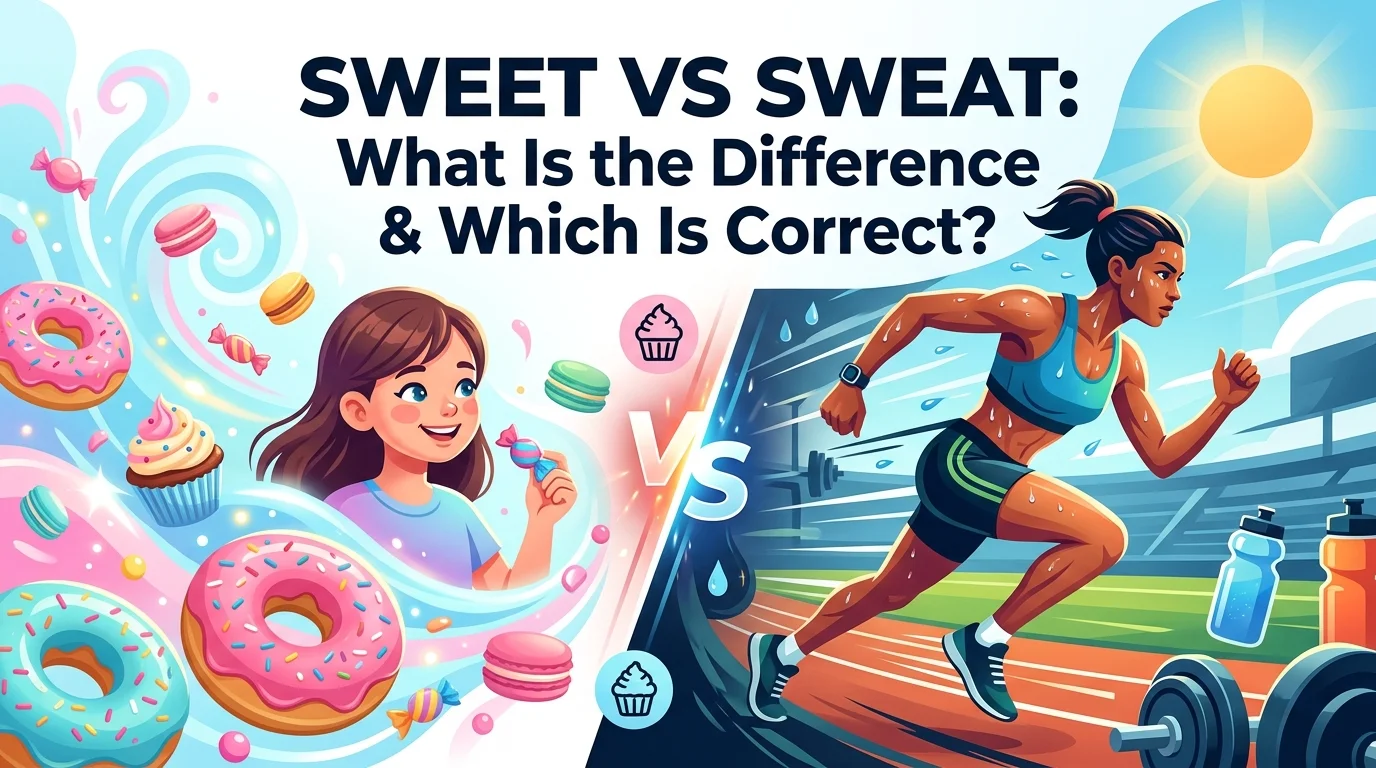

Many English learners confuse “sweet” and “sweat” because they sound somewhat similar but have completely different meanings. One describes something pleasant or sugary, while the other relates to perspiration from the body. Understanding the difference between these two words helps improve grammar, writing accuracy, and everyday communication.
Comparison Overview
“Sweet” and “sweat” are common English words with different meanings, pronunciations, and uses. “Sweet” is usually an adjective connected to taste, kindness, or pleasantness. “Sweat” is mainly a noun or verb related to perspiration caused by heat, exercise, or stress. Since the words look similar, learners often mix them up in speaking and writing.
| Feature | Sweet | Sweat |
| Part of Speech | Mainly adjective | Noun and verb |
| Main Meaning | Sugary, pleasant, kind | Perspiration from the body |
| Related To | Taste, personality, emotions | Heat, exercise, stress |
| Example | The cake is sweet. | I sweat after running. |
| Pronunciation | /swiːt/ | /swet/ |
Definition of Sweet
The word “sweet” describes something pleasant, sugary, kind, or enjoyable. It is commonly used when talking about food, personality, sounds, smells, or emotional moments.
People often use “sweet” to describe desserts, candies, or fruits with sugar. It can also describe someone caring or thoughtful.
Examples:
- The mango tastes sweet.
- She gave me a sweet smile.
- That was a sweet gesture.
- The music sounds sweet.
Definition of Sweat
The word “sweat” refers to the liquid produced by the body when a person is hot, nervous, or physically active. It can function as both a noun and a verb.
As a noun:
- Sweat covered his forehead.
As a verb:
- I sweat a lot during exercise.
“Sweat” is commonly connected to sports, heat, stress, hard work, and physical activity.
Examples:
- Athletes sweat during training.
- The hot weather made everyone sweat.
- Sweat helps cool the body.
Main Differences Between Sweet and Sweat
The biggest difference between “sweet” and “sweat” is meaning and usage.
| Aspect | Sweet | Sweat |
| Meaning | Pleasant, sugary, kind | Body perspiration |
| Usage Type | Descriptive word | Action or physical condition |
| Emotional Connection | Positive emotions | Physical response |
| Common Contexts | Food, personality, music | Exercise, heat, stress |
| Example Sentence | This tea is sweet. | My hands sweat in summer. |
Another important difference is pronunciation. “Sweet” has a long “ee” sound, while “sweat” has a short “e” sound.
Pronunciation Differences
Correct pronunciation helps avoid confusion.
Sweet Pronunciation
“Sweet” sounds like:
- swee-t
- /swiːt/
Words with similar sounds:
- meet
- seat
- greet
Sweat Pronunciation
“Sweat” sounds like:
- swet
- /swet/
Words with similar sounds:
- wet
- set
- get
Common Contexts for Sweet and Sweat
Common Uses of Sweet
“Sweet” is often used in:
- Food descriptions
- Compliments
- Romantic conversations
- Music and sounds
- Friendly behavior
Examples:
- Sweet chocolate
- Sweet child
- Sweet voice
Common Uses of Sweat
“Sweat” is commonly used in:
- Sports
- Fitness
- Hot weather
- Stressful situations
- Physical labor
Examples:
- Sweat after running
- Cold sweat from fear
- Sweat during workouts
Grammar Guide
Understanding grammar rules helps you use “sweet” and “sweat” correctly.
How Each Term Is Used in Sentences
Sweet
“Sweet” is usually an adjective.
Pattern:
- Subject + be verb + sweet
Examples:
- The candy is sweet.
- Your dog is very sweet.
- Her message was sweet.
Sweat
“Sweat” can be a noun or a verb.
As a noun:
- Sweat covered his face.
As a verb:
- They sweat during exercise.
Examples:
- I sweat a lot in summer.
- Sweat dripped from his forehead.
- She began to sweat nervously.
Common Mistakes Learners Make
Many learners accidentally replace one word with another.
Incorrect:
- I feel sweet after the gym.
Correct:
- I feel sweaty after the gym.
Incorrect:
- This juice is sweet.
Correct:
- This juice is sweet.
Another mistake is confusing “sweaty” with “sweet.”
Incorrect:
- He became sweet after running.
Correct:
- He became sweaty after running.
Simple Rules to Remember
- Use “sweet” for pleasant taste or kindness.
- Use “sweat” for body perspiration.
- “Sweet” describes.
- “Sweat” happens physically.
Memory trick:
- “Sweet” has “ee” like “treat.”
- “Sweat” has “ea” like “heat.”
Quick Tips for Writing and Speaking
- Think about the context before choosing the word.
- If discussing flavor or personality, use “sweet.”
- If discussing exercise or heat, use “sweat.”
- Practice pronunciation regularly.
- Read example sentences aloud.
When to Use Each One
Use Sweet When:
- Talking about sugary foods
- Complimenting someone
- Describing kind behavior
- Describing pleasant sounds or smells
- Expressing affection
Examples:
- The cookies are sweet.
- That was sweet of you.
- She has a sweet voice.
Use Sweat When:
- Discussing exercise
- Talking about hot weather
- Describing nervousness
- Mentioning physical effort
- Talking about body reactions
Examples:
- I sweat during football practice.
- Sweat rolled down his face.
- The heat made everyone sweat.
When NOT to Use Each One
Do Not Use Sweet When:
- Talking about perspiration
- Referring to physical exhaustion
- Discussing body cooling
Incorrect:
- I sweet a lot in summer.
Correct:
- I sweat a lot in summer.
Do Not Use Sweat When:
- Talking about candy or flavor
- Complimenting people
- Describing kindness
Incorrect:
- She is a sweat person.
Correct:
- She is a sweet person.
Which One to Use (Decision Guide)
Use this simple guide:
| Situation | Correct Word |
| Sugary taste | Sweet |
| Kind personality | Sweet |
| Pleasant sound | Sweet |
| Body perspiration | Sweat |
| Exercise and heat | Sweat |
| Nervous physical reaction | Sweat |
Ask yourself:
- Is it pleasant or sugary? Use “sweet.”
- Is it related to perspiration? Use “sweat.”
Real-World Practical Examples
Sweet Examples
- The tea became too sweet after adding sugar.
- My grandmother told me a sweet story before bed.
- The singer has a sweet voice.
- That was a sweet email from your teacher.
- The bakery sells sweet pastries every morning.
Sweat Examples
- Players sweat heavily during the match.
- Sweat covered his shirt after the workout.
- I sweat more in humid weather.
- The stressful interview made her sweat.
- Construction workers sweat under the hot sun.
Sweet vs Sweat in Daily Communication
In everyday conversation, these words appear frequently.
Examples:
- “Sweet” often appears in compliments and food discussions.
- “Sweat” commonly appears in fitness and health conversations.
Understanding context makes it easier to choose the correct word naturally.
Why Learners Confuse Sweet and Sweat
Several reasons cause confusion:
- Similar spelling
- Similar starting sounds
- Fast pronunciation in conversations
- Limited vocabulary practice
The best way to avoid mistakes is through repetition, reading, and speaking practice.
Self-Assessment (Fill in the Blanks)
- The candy tastes very ______.
- Athletes usually ______ after intense exercise.
- She wrote me a ______ note.
- My hands ______ during stressful exams.
- The dessert is too ______ for me.
- We began to ______ in the summer heat.
- That was a very ______ compliment.
- Sweat rolled down his face because he could not stop ______.
- The orange juice tastes naturally ______.
- Workers ______ while lifting heavy boxes.
- Her grandmother baked a ______ cake.
- I started to ______ during the football game.
- The child gave his mother a ______ hug.
- Too much running can make you ______ heavily.
- This chocolate is incredibly ______.
- People often ______ in hot weather.
- Your message was very ______ and thoughtful.
- Fear sometimes causes people to ______.
- The tea became less ______ after adding water.
- Hardworking athletes often ______ during training.
Answers
- sweet
- sweat
- sweet
- sweat
- sweet
- sweat
- sweet
- sweating
- sweet
- sweat
- sweet
- sweat
- sweet
- sweat
- sweet
- sweat
- sweet
- sweat
- sweet
- sweat
Final Verdict
“Sweet” and “sweat” may look similar, but they have completely different meanings and uses. “Sweet” relates to pleasant taste, kindness, or enjoyable qualities, while “sweat” refers to body perspiration caused by heat, effort, or stress. By understanding their meanings, pronunciation, grammar, and context, you can confidently use the correct word in both writing and conversation.
Conclusion About Sweet Vs Sweat
Understanding the difference between “sweet” and “sweat” is important for clear and confident English communication. Although these words look and sound somewhat similar, they belong to completely different contexts. “Sweet” usually describes something pleasant, sugary, kind, or enjoyable, while “sweat” refers to perspiration caused by heat, exercise, stress, or physical effort. Learning when and how to use each word correctly can improve your grammar, pronunciation, writing, and daily conversations. The easiest way to remember the difference is to connect “sweet” with positive feelings and flavor, and “sweat” with physical activity and body reactions. By practicing real examples and paying attention to context, you can avoid common mistakes and use both words naturally. Whether you are writing, speaking, studying, or communicating professionally, mastering “sweet” vs “sweat” will make your English more accurate and polished.
FAQs
What is the main difference between sweet and sweat?
“Sweet” describes something pleasant, sugary, kind, or enjoyable, while “sweat” refers to perspiration produced by the body. The two words have different meanings, pronunciations, and grammatical uses. “Sweet” is usually an adjective, while “sweat” can be both a noun and a verb.
Is sweet a noun or an adjective?
“Sweet” is most commonly used as an adjective because it describes taste, personality, or pleasant qualities. However, in some cases, it can also be used as a noun, especially when referring to candy or desserts. In everyday English, it mainly functions as a descriptive word.
Can sweat be used as a verb?
Yes, “sweat” can be used as a verb. It describes the action of producing perspiration due to heat, exercise, nervousness, or physical activity. For example, “I sweat during workouts” uses “sweat” as a verb showing physical action.
Why do learners confuse sweet and sweat?
Learners often confuse these words because they have similar spellings and somewhat similar sounds. Fast pronunciation in conversations can also make them harder to distinguish. Understanding the meanings and practicing pronunciation regularly helps reduce confusion and improves accuracy in speaking and writing.
How do you pronounce sweet correctly?
“Sweet” is pronounced as /swiːt/ with a long “ee” sound. It rhymes with words like “meet” and “seat.” The pronunciation is smoother and longer than “sweat,” which uses a shorter vowel sound.
How do you pronounce sweat correctly?
“Sweat” is pronounced as /swet/ with a short “e” sound. It rhymes with words like “wet” and “get.” The pronunciation is shorter and sharper compared to the longer vowel sound in “sweet.”
Can sweet describe a person?
Yes, “sweet” is commonly used to describe kind, caring, thoughtful, or friendly people. For example, saying “She is very sweet” means the person behaves in a gentle and pleasant way. It is often used as a compliment in conversations.
Is sweat always related to exercise?
No, sweat is not only related to exercise. People can also sweat because of hot weather, stress, fear, illness, or nervousness. The body naturally produces sweat to cool itself and regulate temperature during different situations.
What is the easiest way to remember sweet vs sweat?
A simple way to remember is to connect “sweet” with sugar, kindness, and pleasant things, while “sweat” relates to heat, exercise, and perspiration. Associating each word with its most common context makes choosing the correct one much easier.
Are sweet and sweat interchangeable?
No, these words are not interchangeable because they have completely different meanings. Using the wrong word can make a sentence confusing or grammatically incorrect. Always check whether the sentence refers to pleasant qualities or physical perspiration before choosing the word.
