
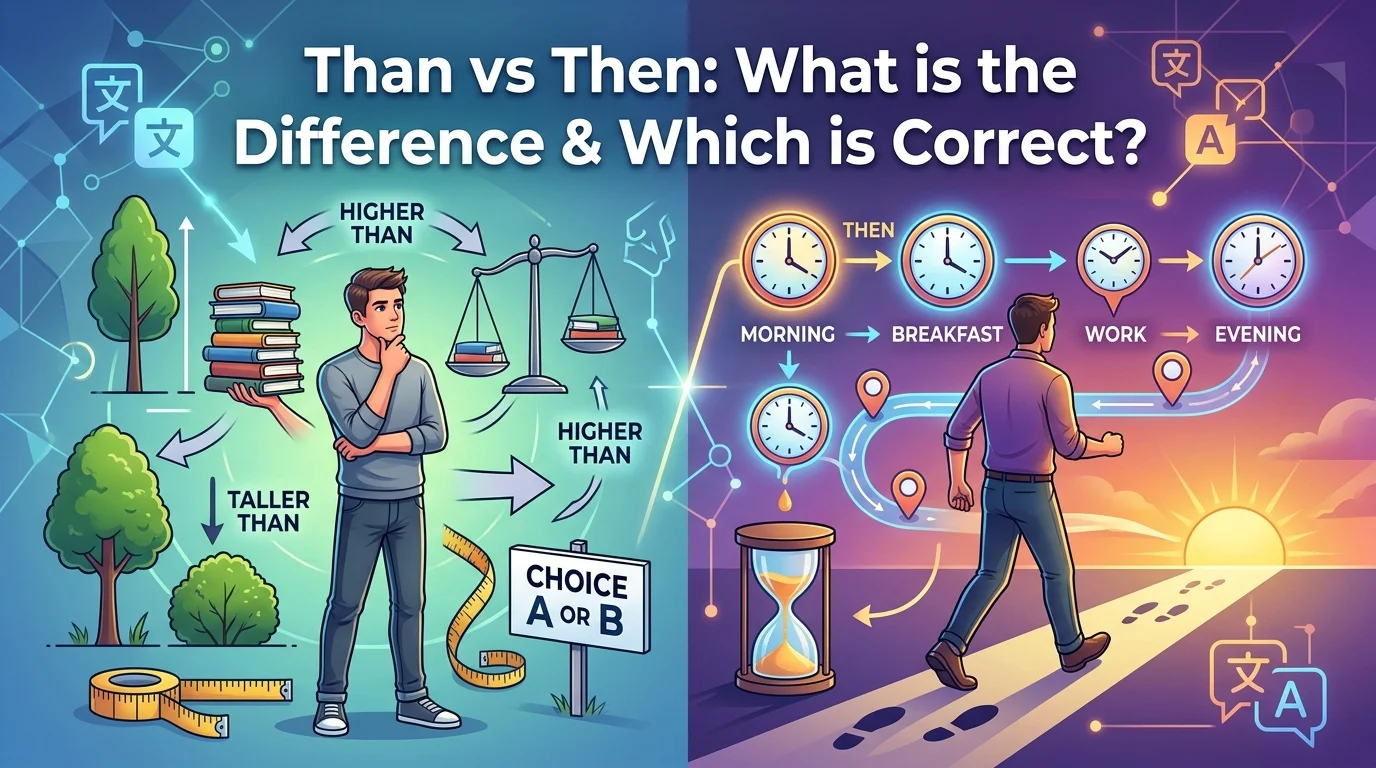

Many English learners confuse “than” and “then” because the words look and sound similar. However, they have very different meanings and uses in grammar. Understanding the difference between than vs then helps you write clearly, avoid mistakes, and communicate more confidently in both speaking and writing.
Comparison Overview
“Than” and “then” are both common English words, but they serve different purposes in sentences. “Than” is mainly used for comparisons, while “then” relates to time, sequence, or results. Although they differ by just one letter, using the wrong one can completely change the meaning of a sentence.
| Feature | Than | Then |
| Main Purpose | Comparison | Time or sequence |
| Part of Speech | Conjunction/Preposition | Adverb/Adjective |
| Common Use | Comparing things | Showing order or time |
| Example | She is taller than me. | We ate dinner, then left. |
Definition of Than
“Than” is a word used to compare two or more things, people, ideas, or situations. It shows differences in degree, amount, size, quality, or preference.
Examples:
- He is faster than his brother.
- This book is better than the movie.
- I would rather stay home than go outside.
The word “than” almost always appears in comparative sentences.
Definition of Then
“Then” refers to time, sequence, or what happens next. It helps organize events or explain the order of actions.
Examples:
- Finish your homework, then watch TV.
- Back then, phones were very expensive.
- If it rains, then we will cancel the trip.
“Then” is commonly used when discussing timelines, instructions, and consequences.
Main Differences Between Than and Then
The biggest difference between than and then is their function in a sentence.
| Aspect | Than | Then |
| Meaning | Comparison | Time/order/result |
| Used With | Comparative words | Actions/events |
| Signals | Difference | Sequence |
| Example | Smaller than a mouse | Eat first, then sleep |
Key Difference in Meaning
- “Than” compares.
- “Then” shows time or sequence.
Examples:
- My car is newer than yours.
- We visited the museum and then went shopping.
Difference in Sentence Structure
“Than” usually follows comparative adjectives such as:
- better
- bigger
- faster
- more
- less
Example:
- She is more organized than her colleague.
“Then” often connects actions or events:
- first
- next
- afterward
Example:
- First study, then relax.
Why People Confuse Than and Then
These words are confusing because:
- They are spelled similarly.
- They sound alike in fast speech.
- Both are very common in English.
- Autocorrect sometimes replaces one incorrectly.
A simple trick is:
- “Than” = comparison
- “Then” = time
Comparison Table for Quick Understanding
| Situation | Correct Word |
| Comparing two objects | Than |
| Talking about what happens next | Then |
| Choosing between options | Than |
| Explaining sequence | Then |
| Showing preference | Than |
| Referring to a past time | Then |
Grammar Guide
Understanding grammar rules makes it easier to use than and then correctly.
How each term is used in sentences
Using “Than”
Pattern:
- Comparative adjective + than + noun/pronoun
Examples:
- This laptop is cheaper than that one.
- She sings better than I do.
- Water is healthier than soda.
Using “Then”
Pattern:
- Action/event + then + next action
Examples:
- Wash your hands, then eat.
- We finished work and then traveled home.
- If you agree, then we can continue.
Common mistakes learners make
Mistake 1: Using “then” for comparison
Incorrect:
- She is smarter then me.
Correct:
- She is smarter than me.
Mistake 2: Using “than” for time
Incorrect:
- We went shopping than ate dinner.
Correct:
- We went shopping then ate dinner.
Mistake 3: Confusing pronunciation with spelling
People often type the wrong word because both sound similar in conversation.
Simple rules to remember
- Use “than” when comparing.
- Use “then” when talking about time.
- If the sentence includes words like “better,” “more,” or “less,” use “than.”
- If the sentence involves steps or order, use “then.”
Memory Tip:
- “A” in “than” = compare
- “E” in “then” = event/time
Quick tips for writing and speaking
- Pause and ask: “Am I comparing?”
- If yes, use “than.”
- Ask: “Am I showing sequence or time?”
- If yes, use “then.”
- Proofread comparative sentences carefully.
- Practice with short example sentences daily.
When to Use Each One
When to Use “Than”
Use “than” when:
- Comparing people or things
- Showing preference
- Discussing differences
- Measuring quantity or quality
Examples:
- Tea is healthier than soda.
- I would rather read than watch TV.
- This phone costs less than that one.
When to Use “Then”
Use “then” when:
- Describing steps
- Talking about time
- Explaining consequences
- Referring to the past
Examples:
- Finish your project, then submit it.
- Life was different back then.
- If you study hard, then you may succeed.
When NOT to Use Each One
When NOT to Use “Than”
Do not use “than”:
- For timelines
- For sequences
- For instructions
Incorrect:
- Brush your teeth than sleep.
Correct:
- Brush your teeth then sleep.
When NOT to Use “Then”
Do not use “then”:
- In comparisons
- After comparative adjectives
Incorrect:
- This bag is heavier then mine.
Correct:
- This bag is heavier than mine.
Which One to Use (Decision Guide)
Use this simple guide:
| Ask Yourself | Correct Word |
| Am I comparing? | Than |
| Am I talking about time? | Then |
| Does the sentence include “better,” “more,” or “less”? | Than |
| Does the sentence describe steps? | Then |
| Is it about preference? | Than |
| Is it about what happens next? | Then |
Real-World Practical Examples
Than Examples
- Education: Math is harder than history for some students.
- Daily Life: Walking is healthier than driving short distances.
- Technology: This computer runs faster than the old model.
- Business: Our company performed better than last year.
- Conversation: I know her better than you do.
- Science: Gold is heavier than aluminum.
- Writing: Short sentences are often clearer than long ones.
Then Examples
- Education: Read the chapter, then answer the questions.
- Daily Life: We cleaned the house and then relaxed.
- Technology: Install the software, then restart the computer.
- Business: The manager reviewed the report, then approved it.
- Conversation: I was shy back then.
- Science: Heat the liquid, then measure the temperature.
- Writing: First create an outline, then start drafting.
Self-Assessment (Fill in the Blanks)
- My sister is taller ______ me.
- Finish your lunch, ______ wash the dishes.
- This movie is more exciting ______ the first one.
- We visited the park and ______ went home.
- I would rather study ______ fail the exam.
- Back ______, people used handwritten letters.
- Your idea is better ______ mine.
- Mix the ingredients and ______ bake the cake.
- He earns more money ______ his brother.
- If you practice daily, ______ you will improve.
- This route is shorter ______ the highway.
- She called me and ______ sent an email.
- I prefer tea rather ______ coffee.
- Complete the form, ______ submit it online.
- My phone is newer ______ yours.
- We lived in another city back ______.
- Learning grammar is easier ______ before.
- First turn on the machine, ______ press the button.
- She is more experienced ______ her coworker.
- If the weather improves, ______ we can travel.
Answers
- than
- then
- than
- then
- than
- then
- than
- then
- than
- then
- than
- then
- than
- then
- than
- then
- than
- then
- than
- then
Final Verdict
Understanding the difference between than vs then is essential for correct English grammar and clear communication. “Than” is used for comparisons, while “then” is used for time, sequence, or results. Even though the words look similar, their meanings are completely different. A simple way to remember them is that “than” compares and “then” connects events or time. By practicing common sentence patterns and reviewing examples, you can quickly master their correct usage. Whether you are writing essays, emails, business documents, or casual conversations, choosing the correct word will make your English more accurate and professional.
Conclusion About Than vs Then
Understanding the difference between than vs then can make your English clearer, smoother, and more professional. While these two words may look similar, they play completely different roles in grammar and everyday communication. “Than” is mainly used for comparisons, while “then” helps describe time, sequence, or results. Learning when to use each one correctly improves writing, speaking, academic work, and even casual conversations. The good news is that the distinction becomes easier with regular practice and simple memory tricks. Whether you are writing emails, essays, social media captions, or business documents, choosing the correct word helps your message sound polished and accurate. By focusing on context and sentence meaning, you can avoid one of the most common English grammar mistakes and use both words with confidence in any situation.
FAQs
What is the main difference between than and then?
“Than” is used for comparisons, while “then” is used for time, sequence, or results. For example, “She is taller than me” compares two people, while “We ate dinner, then watched a movie” describes events in order. Understanding this basic distinction helps avoid common grammar mistakes in writing and speaking.
Is it better then or better than?
The correct phrase is “better than.” The word “better” is a comparative adjective, so it must be followed by “than” when comparing two things. For example, “This book is better than the last one” is correct. Using “then” in this sentence would create a grammar error because no sequence or time is involved.
Can then be used in comparisons?
No, “then” should not be used for comparisons. Comparisons require “than.” The word “then” is only used when talking about time, order, consequences, or sequence. For example, “He is faster than me” is correct, while “He is faster then me” is incorrect because the sentence compares two people.
Why do people confuse than and then?
People confuse these words because they look and sound very similar, especially in fast speech. Both are short, common English words used frequently in everyday conversations and writing. Many learners also type the wrong one accidentally because of spelling habits or autocorrect. Remembering their separate functions helps reduce confusion.
How can I remember the difference between than and then?
A simple trick is to connect “than” with comparison and “then” with time. Another memory tip is that “then” contains the letter “e,” which can remind you of events or order. Practicing short example sentences regularly also helps reinforce the correct usage naturally in everyday communication.
Is than a conjunction or preposition?
“Than” can function as both a conjunction and a preposition depending on the sentence structure. In many comparisons, it connects two parts of a sentence. For example, “She is taller than I am” uses it as a conjunction, while “She is taller than me” often treats it like a preposition in modern English usage.
What does then mean in grammar?
In grammar, “then” usually acts as an adverb that refers to time, sequence, or consequence. It helps explain what happens next or when something happened. For example, “Finish your homework, then go outside” shows sequence, while “Back then, life was simpler” refers to a specific past time.
Can than and then change the meaning of a sentence?
Yes, using the wrong word can completely change the meaning or make a sentence grammatically incorrect. “Than” creates comparisons, while “then” describes time or sequence. For example, “I would rather walk than drive” expresses preference, while “I walked, then drove home” describes actions happening in order.
Are than and then commonly tested in English exams?
Yes, these words are commonly tested in grammar exams, language quizzes, and school assignments because they are often confused. Teachers and examiners check whether students understand comparisons versus sequence. Learning the difference thoroughly helps improve grammar accuracy in academic writing, professional communication, and standardized English tests.
Can I use then at the beginning of a sentence?
Yes, “then” can appear at the beginning of a sentence when referring to sequence, conclusion, or time. For example, “Then we decided to leave early” is correct. It is often used in storytelling, instructions, and conversations to guide readers or listeners through events in a logical order.
