
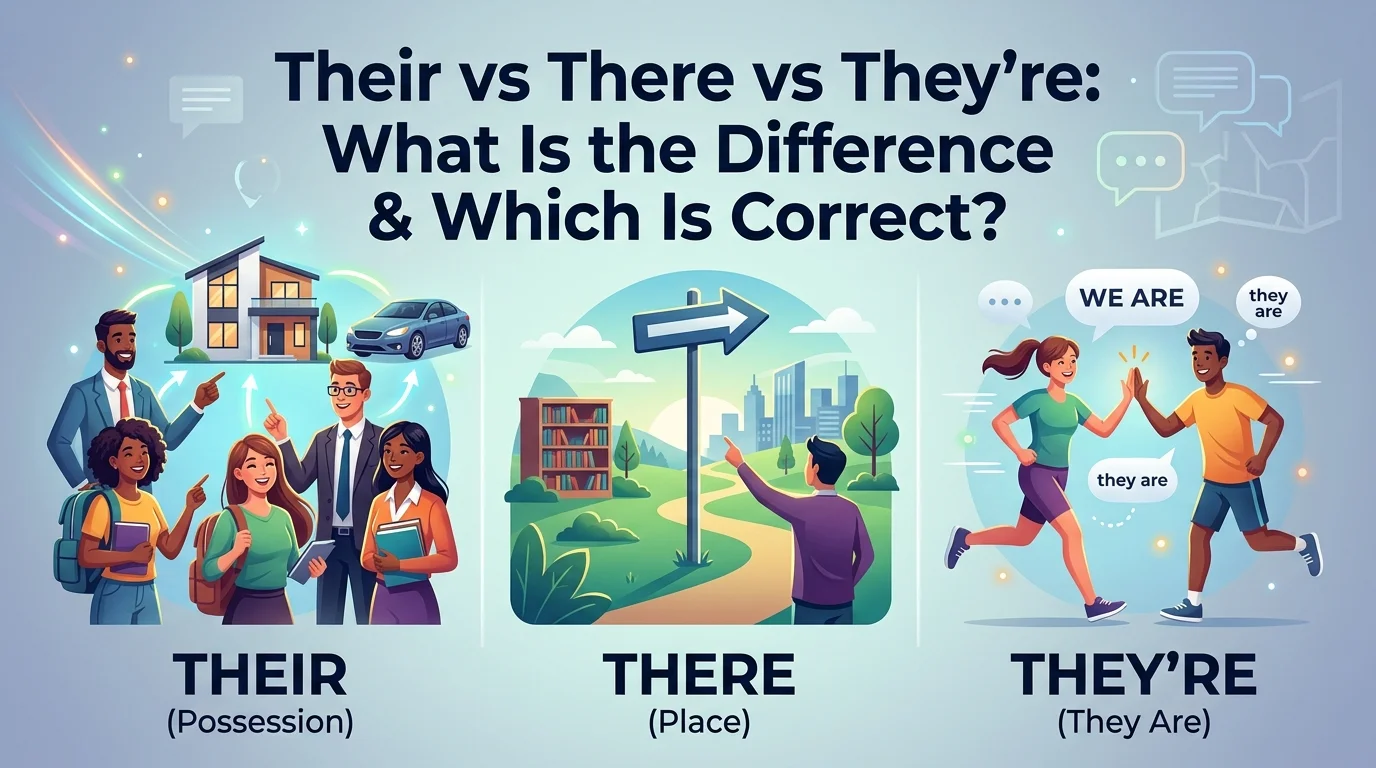

Many English learners confuse their, there, and they’re because these words sound alike but have completely different meanings and grammatical functions. Using the wrong one can make writing look incorrect and confusing. Understanding the differences between these commonly mixed-up words will help you write and speak English more accurately and confidently.
Comparison Overview
Their, there, and they’re are homophones, meaning they are pronounced similarly but have different spellings and meanings.
| Word | Part of Speech | Meaning | Example |
| Their | Possessive determiner | Shows ownership or belonging | Their car is new. |
| There | Adverb, pronoun, noun | Refers to a place or existence | The book is over there. |
| They’re | Contraction | Short form of “they are” | They’re happy today. |
Understanding the role each word plays in a sentence is the key to using them correctly.
Definition of Their
Their is a possessive determiner that shows ownership, possession, or belonging. It indicates that something belongs to a group of people or individuals referred to as “they.”
Examples:
- Their house is beautiful.
- Their teacher gave them homework.
- Their ideas helped solve the problem.
Whenever you want to show that something belongs to people, their is usually the correct choice.
Definition of There
There most commonly refers to a place, location, position, or existence. It can also be used to introduce sentences.
Examples:
- Put the bag over there.
- There is a cat in the garden.
- We went there yesterday.
The word there often answers the question “where?”
Definition of They’re
They’re is a contraction of they are.
Examples:
- They’re studying for the exam.
- They’re planning a vacation.
- They’re ready to begin.
A useful test is to replace they’re with they are. If the sentence still makes sense, they’re is correct.
Main Differences Between Their, There, and They’re
The primary differences involve meaning, grammar, and usage.
| Feature | Their | There | They’re |
| Function | Shows ownership | Refers to place or existence | Means “they are” |
| Grammar Type | Possessive determiner | Adverb/pronoun | Contraction |
| Indicates Possession | Yes | No | No |
| Indicates Location | No | Yes | No |
| Can Be Expanded | No | No | Yes, to “they are” |
| Example | Their books are here. | The books are there. | They’re reading books. |
Quick Comparison
- Their = belongs to them.
- There = location or existence.
- They’re = they are.
Why These Words Are Commonly Confused
These three words are pronounced almost identically in everyday speech. Because English spelling does not always match pronunciation, writers often accidentally choose the wrong form.
For example:
- Incorrect: There dog is friendly.
- Correct: Their dog is friendly.
- Incorrect: Their going to school.
- Correct: They’re going to school.
The confusion happens because the sound is the same, but the meaning changes completely.
Comparison Table with Examples
| Sentence Purpose | Correct Word |
| Showing ownership | Their |
| Referring to a location | There |
| Replacing “they are” | They’re |
| Describing possession | Their |
| Talking about existence | There |
| Describing an action by a group | They’re |
Grammar Guide
How Each Term Is Used in Sentences
Their
Pattern:
- Their + noun
Examples:
- Their project won first place.
- Their computer needs repair.
There
Patterns:
- There + location
- There is/are + noun
Examples:
- There is a problem.
- The keys are over there.
They’re
Pattern:
- They’re + adjective/verb/noun phrase
Examples:
- They’re excited.
- They’re working late.
Common Mistakes Learners Make
- Using there instead of their.
- Using their instead of they’re.
- Forgetting that they’re means “they are.”
- Using there when talking about ownership.
- Choosing words based on sound rather than meaning.
Examples:
- Incorrect: There house is large.
- Correct: Their house is large.
- Incorrect: Their going shopping.
- Correct: They’re going shopping.
Simple Rules to Remember
- Their contains “heir,” which can remind you of ownership.
- There contains “here,” which can remind you of location.
- They’re always means “they are.”
Memory Trick:
- Their = possession
- There = place
- They’re = they are
Quick Tips for Writing and Speaking
- Check whether ownership is involved.
- Ask whether the sentence refers to a place.
- Replace the word with “they are” to test for they’re.
- Proofread carefully because spell-checkers may miss these mistakes.
- Focus on meaning rather than pronunciation.
When to Use Each One
Use Their When:
- Showing ownership
- Referring to belongings
- Describing something owned by people
Examples:
- Their car is parked outside.
- Their research was successful.
Use There When:
- Referring to a location
- Indicating existence
- Pointing something out
Examples:
- There is a solution.
- We stayed there overnight.
Use They’re When:
- You mean “they are”
- Describing actions or conditions of a group
Examples:
- They’re learning English.
- They’re ready to leave.
When NOT to Use Each One
Do Not Use Their
Avoid using their when:
- Talking about a place
- Replacing “they are”
Incorrect:
- Their is a problem.
Correct:
- There is a problem.
Do Not Use There
Avoid using there when:
- Showing ownership
- Replacing “they are”
Incorrect:
- There books are missing.
Correct:
- Their books are missing.
Do Not Use They’re
Avoid using they’re when:
- Showing possession
- Referring to a location
Incorrect:
- They’re house is large.
Correct:
- Their house is large.
Which One to Use (Decision Guide)
Ask yourself these questions:
- Does something belong to people?
- Use their.
- Are you talking about a place or existence?
- Use there.
- Can you replace the word with “they are”?
- Use they’re.
Quick Decision Chart:
| Question | Correct Choice |
| Ownership? | Their |
| Location? | There |
| Means “they are”? | They’re |
Real-World Practical Examples
Their Examples
- Their classroom was renovated this year.
- Their family moved to a new city.
- Their experiment produced accurate results.
- Their company launched a new product.
- Their website received thousands of visitors.
There Examples
- There is a library near the school.
- We left the equipment there yesterday.
- There are many stars visible tonight.
- The file is stored there on the server.
- There was a meeting this morning.
They’re Examples
- They’re preparing for final exams.
- They’re discussing the project proposal.
- They’re conducting scientific research.
- They’re launching a software update next week.
- They’re enjoying dinner with friends.
Self-Assessment (Fill in the Blanks)
- I will use ______ when referring to ownership of a bicycle.
- The correct word is ______ because it means “they are excited.”
- I will use ______ when referring to a location across the street.
- The correct word is ______ because the books belong to students.
- I will use ______ when describing existence in a sentence.
- The correct word is ______ because it means “they are studying.”
- I will use ______ when referring to someone’s belongings.
- The correct word is ______ because it identifies a place.
- I will use ______ when replacing “they are working.”
- The correct word is ______ because it shows possession.
- I will use ______ when talking about where an object is located.
- The correct word is ______ because the sentence means “they are ready.”
- I will use ______ when describing a group’s property.
- The correct word is ______ because it introduces an existing object.
- I will use ______ when referring to ownership of a business.
- The correct word is ______ because it can be expanded to “they are.”
- I will use ______ when pointing to a distant place.
- The correct word is ______ because the item belongs to them.
- I will use ______ when stating that something exists.
- The correct word is ______ because it means “they are participating.”
Answers
- Their
- They’re
- There
- Their
- There
- They’re
- Their
- There
- They’re
- Their
- There
- They’re
- Their
- There
- Their
- They’re
- There
- Their
- There
- They’re
Final Verdict
Their, there, and they’re may sound alike, but each serves a unique purpose in English grammar. Use their for ownership and possession, there for places or existence, and they’re whenever you mean they are. By remembering these simple distinctions and applying the substitution test for they’re, you can avoid one of the most common mistakes in English writing and communicate with greater clarity and confidence.
Conclusion About Their vs There vs They’re
Understanding the difference between their, there, and they’re is essential for clear and accurate English communication. Although these words sound alike, they serve very different purposes in grammar. Their shows ownership, there refers to a place or indicates existence, and they’re is simply a contraction of they are. Mixing them up is common, even among native speakers, but a few simple rules can make choosing the correct word much easier. Whenever you write, take a moment to consider whether you are talking about possession, location, or a group of people performing an action. With regular practice, the distinction becomes natural and automatic. Mastering these commonly confused words will improve your writing, strengthen your grammar skills, and help you communicate more confidently in school, business, everyday conversations, and professional settings.
FAQs
What is the difference between their, there, and they’re?
Their shows ownership, there refers to a place or existence, and they’re is a contraction of “they are.” Although they sound similar, each word has a different meaning and grammatical function.
How can I remember when to use their?
Use their whenever something belongs to a person or group. A helpful reminder is that their is related to ownership and possession, such as “their house” or “their books.”
When should I use there in a sentence?
Use there when talking about a location, direction, or existence. Examples include “The store is over there” and “There is a problem with the computer.”
Is they’re always a contraction?
Yes. They’re is always the shortened form of “they are.” If you can replace the word with “they are” and the sentence still makes sense, they’re is the correct choice.
Why do people confuse their, there, and they’re?
People confuse these words because they are homophones. They sound almost identical when spoken, but they have different spellings, meanings, and grammatical roles.
Can their be used for singular people?
Yes. Modern English often uses their as a singular gender-neutral possessive pronoun. For example, “Each student should bring their notebook.”
Is there a noun or an adverb?
There can function as different parts of speech depending on the sentence. It is commonly used as an adverb of place, but it can also introduce sentences expressing existence.
What is the easiest way to check if they’re is correct?
Replace they’re with “they are.” If the sentence still sounds correct and keeps the same meaning, then using they’re is appropriate.
Are these words important in professional writing?
Yes. Using the correct form demonstrates strong grammar skills and attention to detail. Errors involving their, there, and they’re can affect the clarity and professionalism of your writing.
Can grammar checkers always catch these mistakes?
Not always. Since their, there, and they’re are all correctly spelled words, some grammar tools may miss errors. Careful proofreading is still important for accuracy.
