
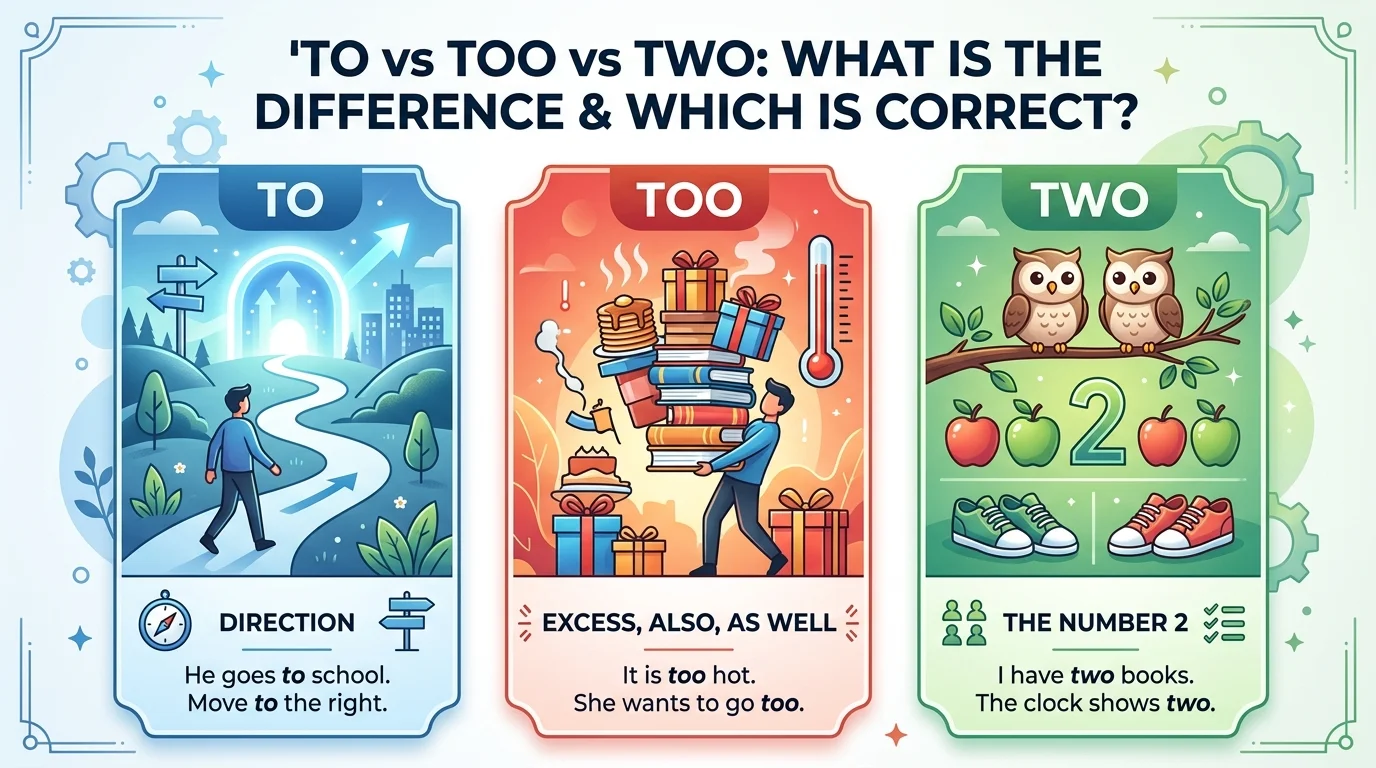

Many English learners confuse to, too, and two because they sound exactly alike. Although these words are pronounced the same, they have very different meanings and grammatical functions. Understanding the difference is essential for clear writing and speaking. This guide explains each word in simple language and shows exactly when and how to use them correctly.
Comparison Overview
The words to, too, and two are commonly confused because they are homophones, meaning they sound the same but have different meanings and spellings.
| Word | Part of Speech | Main Meaning |
| To | Preposition/Infinitive Marker | Shows direction, destination, relationship, or forms infinitive verbs |
| Too | Adverb | Means “also” or “excessively” |
| Two | Number | The number 2 |
Knowing which one to use depends entirely on the meaning you want to express.
Definition of To
To is one of the most commonly used words in English. It usually functions as a preposition or as part of an infinitive verb.
Examples:
- I am going to school.
- She gave the book to her friend.
- I want to learn English.
The word to often shows direction, movement, purpose, or connection between things.
Definition of Too
Too is an adverb that usually means also or more than necessary.
Examples:
- I want to come too.
- The coffee is too hot.
- She is too tired to work.
It is used when adding information or showing excess.
Definition of Two
Two is the number that comes after one and before three.
Examples:
- I have two brothers.
- We bought two tickets.
- The project lasted two weeks.
Whenever you are referring to the number 2, the correct word is two.
Main Differences Between To, Too, and Two
The primary difference lies in meaning and grammatical function.
| Word | Function | Example |
| To | Shows direction or forms infinitives | I want to study. |
| Too | Means also or excessively | I want to study too. |
| Two | Refers to the number 2 | I have two books. |
Key Distinctions
- To connects words and ideas.
- Too adds emphasis or means “also.”
- Two refers strictly to quantity.
Why People Confuse To, Too, and Two
These three words are homophones.
Reasons for confusion include:
- Identical pronunciation.
- Similar appearance in writing.
- Fast typing errors.
- Lack of attention to context.
Understanding the meaning of the sentence usually reveals the correct choice.
Comparison Table
| Feature | To | Too | Two |
| Meaning | Direction, purpose, infinitive | Also, excessively | Number 2 |
| Part of Speech | Preposition/Marker | Adverb | Number/Adjective |
| Indicates Quantity | No | No | Yes |
| Indicates Addition | No | Yes | No |
| Used Before Verbs | Yes | No | No |
| Example | To run | Too fast | Two apples |
Grammar Guide
Understanding grammar makes choosing the correct word much easier.
How Each Term Is Used in Sentences
To
Patterns:
- To + Place
- To + Person
- To + Verb
Examples:
- Go to work.
- Give it to him.
- Want to sleep.
Too
Patterns:
- Statement + too
- Too + adjective
Examples:
- I like pizza too.
- It is too expensive.
Two
Patterns:
- Two + noun
Examples:
- Two cars.
- Two students.
Common Mistakes Learners Make
Incorrect:
- I have to sisters.
- She wants two come.
- The bag is to heavy.
Correct:
- I have two sisters.
- She wants to come.
- The bag is too heavy.
Simple Rules to Remember
- If it means direction or a verb connection, use to.
- If it means also or excessively, use too.
- If it means the number 2, use two.
Quick Tips for Writing and Speaking
- Replace the word with “also.” If it fits, use too.
- Check whether a number is involved. If yes, use two.
- If a verb follows, to is usually correct.
When to Use Each One
Use To When
- Showing movement.
- Showing purpose.
- Connecting a verb in infinitive form.
Examples:
- Drive to the office.
- Need to study.
- Send it to me.
Use Too When
- Meaning “also.”
- Showing excess.
Examples:
- I am coming too.
- It is too cold.
Use Two When
- Referring to quantity.
Examples:
- Two children.
- Two months.
- Two computers.
When NOT to Use Each One
Do Not Use To
- When referring to the number 2.
- When meaning “also.”
Incorrect:
- I have to dogs.
Do Not Use Too
- Before infinitive verbs.
- When counting objects.
Incorrect:
- I want too learn.
Do Not Use Two
- To show direction.
- To mean “also.”
Incorrect:
- I went two school.
Which One to Use (Decision Guide)
Ask yourself these questions:
- Am I talking about the number 2?
- Yes → Two
- Do I mean “also” or “excessively”?
- Yes → Too
- Am I showing direction, purpose, or using a verb infinitive?
- Yes → To
This simple process will help you choose correctly every time.
Real-World Practical Examples
To Examples
- Students go to school every morning.
- Scientists continue to research climate change.
- Employees report to their manager.
- I need to update the software.
- She traveled to London for a conference.
Too Examples
- The homework is too difficult.
- I enjoy reading books too.
- The computer is too slow.
- The meeting lasted too long.
- He wants to participate too.
Two Examples
- The teacher assigned two projects.
- We purchased two laptops.
- The experiment lasted two hours.
- She has two certifications.
- The company opened two new branches.
Self-Assessment (Fill in the Blanks)
- I am going ______ the library.
- The soup is ______ hot to eat.
- She owns ______ bicycles.
- We want ______ improve our skills.
- He is coming ______.
- There are ______ solutions to the problem.
- Send the email ______ the manager.
- The box is ______ heavy.
- I bought ______ notebooks.
- They hope ______ win the competition.
- I would like to join ______.
- The classroom has ______ doors.
- We traveled ______ another city.
- This assignment is ______ difficult.
- The team hired ______ new employees.
- She plans ______ start a business.
- I enjoy music ______.
- The bag contains ______ bottles.
- He wants ______ learn coding.
- The weather is ______ cold today.
Answers
- To
- Too
- Two
- To
- Too
- Two
- To
- Too
- Two
- To
- Too
- Two
- To
- Too
- Two
- To
- Too
- Two
- To
- Too
Final Verdict
Although to, too, and two sound exactly the same, they serve completely different purposes in English. To is mainly used for direction, purpose, and infinitive verbs. Too means “also” or “more than necessary.” Two refers exclusively to the number 2. By focusing on the meaning of the sentence rather than pronunciation, you can easily choose the correct word. Remember: to connects, too adds or emphasizes, and two counts. Mastering these distinctions will improve your grammar, writing accuracy, and overall confidence in English communication.
Conclusion About To vs Too vs Two
Understanding the difference between to, too, and two is an important step toward improving your English grammar and communication skills. Although these three words sound identical, their meanings and functions are completely different. To is used for direction, purpose, and infinitive verbs, too means also or excessively, and two represents the number after one. By paying attention to the context of a sentence, you can quickly determine which word is correct. Whether you are writing emails, completing school assignments, creating business documents, or having everyday conversations, using these words accurately helps your message remain clear and professional. The more you practice recognizing their unique roles, the easier it becomes to avoid common mistakes. Remember that pronunciation may be the same, but meaning is what matters. Mastering to vs too vs two will make your writing more polished, confident, and grammatically correct.
FAQs
What is the difference between to, too, and two?
The main difference is their meaning and usage. To is used for direction, purpose, or before a verb. Too means also or excessively. Two refers to the number two. Even though they sound alike, they perform completely different grammatical functions in sentences.
Why are to, too, and two often confused?
These words are confused because they are homophones, which means they have the same pronunciation but different meanings and spellings. Many writers rely on sound rather than context, leading to mistakes. Understanding the role each word plays in a sentence helps eliminate confusion.
Is “too” the same as “also”?
Yes, too can mean also in many situations. It is commonly placed at the end of a sentence to indicate addition. For example, “I want to come too” means the same thing as “I also want to come.”
Can “to” be used before every verb?
Not every verb uses to, but many infinitive forms do. Examples include “to learn,” “to write,” and “to travel.” However, some verbs follow different grammatical patterns and may not require to before another verb.
When should I use the word “two”?
Use two whenever you are talking about the number or quantity of something. It always refers to the numerical value after one and before three. Examples include two books, two days, or two students.
How can I remember the difference between too and two?
A simple trick is to notice that too has an extra “o,” which can remind you of “extra” or “also.” Two contains the letter “w,” which helps identify it as the number word rather than an adverb.
Is it correct to say “me too”?
Yes, “me too” is a common and grammatically acceptable expression in informal and conversational English. It is used to show agreement or indicate that the same statement applies to you as well.
Can “to” show direction?
Yes, one of the most common uses of to is showing movement or direction. For example, “She walked to the store” and “They traveled to another country” both use to to indicate a destination.
Are to, too, and two important in formal writing?
Absolutely. These words appear frequently in professional emails, reports, academic papers, and business communication. Using the wrong word can create confusion and make writing appear less polished or less accurate.
What is the easiest way to choose the correct word?
First, check the meaning you want. If you mean a destination or infinitive verb, use to. If you mean also or excessively, use too. If you mean the number after one, use two. Context always provides the answer.
