
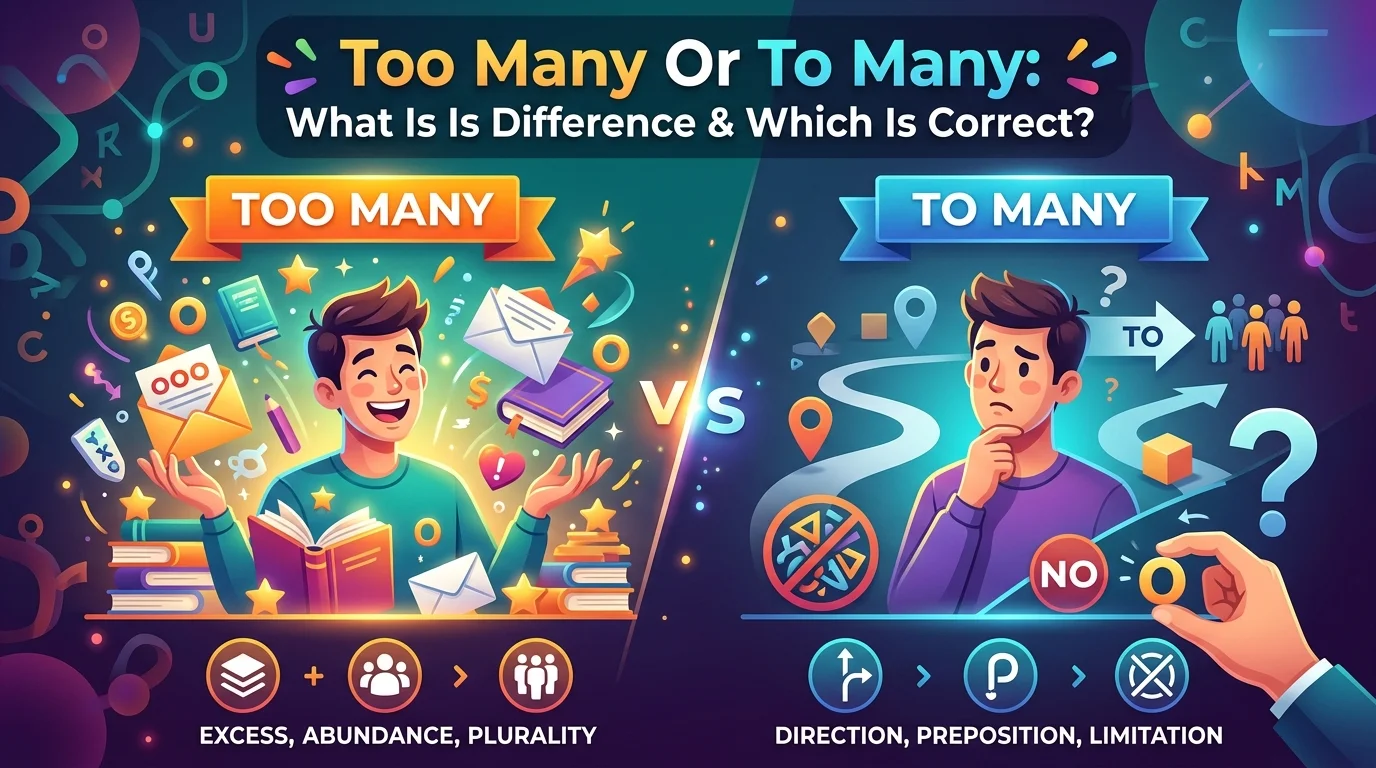

Many English learners confuse “too many” and “to many” because the phrases look very similar. However, they have completely different meanings and grammatical functions. Understanding the difference helps you write clearer sentences, avoid common grammar mistakes, and communicate more naturally in both speaking and writing.
Comparison Overview
“Too many” and “to many” may sound alike, but they are used in different ways. “Too many” expresses excess or a quantity greater than needed, while “to many” usually appears when the preposition “to” connects with the adjective or pronoun “many.” In everyday English, “too many” is far more common and usually the correct choice.
| Phrase | Meaning | Common Usage | Correctness |
| Too many | More than needed or acceptable | Very common | Usually correct in quantity expressions |
| To many | Preposition + adjective/pronoun | Less common | Correct only in specific sentence structures |
Definition of Too Many
“Too many” means an excessive number of something countable. It is used when there are more people, objects, or situations than desired or acceptable.
It often shows complaint, overload, or difficulty.
Examples:
- There are too many cars on the road.
- She has too many assignments this week.
- We invited too many guests.
The phrase is commonly used before plural countable nouns.
Definition of To Many
“To many” is a combination of the preposition “to” and the word “many.” It does not express excess. Instead, it usually connects one part of a sentence to another.
Examples:
- The speech appealed to many people.
- This issue matters to many students.
- The book is useful to many readers.
Here, “to” functions as a preposition, while “many” refers to a large number of people or things.
Main Differences Between Too Many and To Many
The biggest difference is meaning and grammatical function.
| Feature | Too Many | To Many |
| Meaning | Excessive amount | Direction, relation, or connection |
| Grammar Type | Quantifier phrase | Preposition + adjective/pronoun |
| Commonness | Very common | Less common |
| Used Before Nouns | Yes | Usually no |
| Expresses Excess | Yes | No |
Key Difference in Meaning
- “Too many” means more than necessary.
- “To many” simply connects ideas in a sentence.
Examples:
- There are too many errors in the report. ✔
- The report matters to many employees. ✔
Difference in Sentence Structure
“Too many” is usually followed by a plural noun.
Pattern:
- too many + plural noun
Example:
- too many books
“To many” usually appears after a verb or adjective.
Pattern:
- verb/adjective + to many
Example:
- important to many
Common Situations Where Confusion Happens
People often type “to many” when they actually mean “too many” because both phrases sound identical in speech.
Incorrect:
- I have to many emails.
Correct:
- I have too many emails.
The mistake usually happens because “too” and “to” are homophones.
Comparison Table With Examples
| Incorrect Usage | Correct Usage | Explanation |
| To many people attended. | Too many people attended. | Excess quantity requires “too many.” |
| This matters too many users. | This matters to many users. | Preposition needed before “many.” |
| There are to many files. | There are too many files. | Quantity is excessive. |
| The idea appealed too many readers. | The idea appealed to many readers. | Verb requires “to.” |
Grammar Guide
Understanding the grammar behind these phrases makes choosing the correct one much easier.
How Each Term Is Used in Sentences
Too Many
Pattern:
- too many + plural noun
Examples:
- There are too many students in the classroom.
- He bought too many snacks.
- We received too many complaints.
To Many
Pattern:
- verb/adjective + to many
Examples:
- The message was helpful to many workers.
- The event appealed to many tourists.
- This change matters to many families.
Common Mistakes Learners Make
Using “to” Instead of “too”
Incorrect:
- There are to many options.
Correct:
- There are too many options.
Forgetting That “Too Many” Needs a Plural Noun
Incorrect:
- Too many water
Correct:
- Too much water
Using “Too Many” Without Excess Meaning
Incorrect:
- The movie was too many viewers.
Correct:
- The movie appealed to many viewers.
Simple Rules to Remember
- Use “too many” when talking about excess.
- Use “to many” when “to” acts as a preposition.
- If you can replace the phrase with “excessive,” choose “too many.”
- If the sentence connects something “to” a group, use “to many.”
Quick Tips for Writing and Speaking
- Check whether you are describing excess quantity.
- Look for plural nouns after “too many.”
- Read the sentence carefully to see if “to” is linking ideas.
- Remember that “too” often means “more than enough.”
When to Use Each One
Use “Too Many” When:
- Describing excess people or things
- Complaining about quantity
- Talking about overload
- Discussing countable nouns
Examples:
- Too many emails
- Too many students
- Too many mistakes
Use “To Many” When:
- “To” works as a preposition
- Connecting actions or ideas
- Referring to a large group indirectly
Examples:
- Important to many
- Helpful to many
- Attractive to many
When NOT to Use Each One
Do Not Use “Too Many” When:
- There is no idea of excess
- The noun is uncountable
- The sentence needs a preposition
Incorrect:
- This is too many people.
Correct: - This is important to many people.
Do Not Use “To Many” When:
- You mean “more than enough”
- Talking about excessive quantity
Incorrect:
- We invited to many guests.
Correct: - We invited too many guests.
Which One to Use (Decision Guide)
Ask yourself these questions:
Are you talking about excess?
If yes, use “too many.”
Example:
- There are too many ads on this website.
Is “to” connecting something with people or objects?
If yes, use “to many.”
Example:
- The message was meaningful to many readers.
Is a plural noun directly after the phrase?
If yes, “too many” is usually correct.
Example:
- too many books
Real-World Practical Examples
Too Many Examples
- The teacher assigned too many homework tasks this weekend.
- There are too many notifications on my phone.
- Scientists recorded too many errors in the experiment.
- The company hired too many temporary workers.
- We packed too many clothes for the trip.
To Many Examples
- The charity program brought hope to many families.
- This software is useful to many businesses.
- The speech was inspiring to many students.
- The update matters to many technology users.
- The medical discovery was beneficial to many patients.
Self-Assessment (Fill in the Blanks)
- There are ______ students in the hallway right now.
- The announcement was important ______ employees.
- We bought ______ snacks for the party.
- This issue matters ______ parents.
- The writer added ______ details to the article.
- The training program was helpful ______ workers.
- I received ______ phone calls today.
- The decision seemed unfair ______ citizens.
- She carried ______ books in her backpack.
- The app is useful ______ teachers.
- The restaurant accepted ______ reservations.
- The speech connected emotionally ______ listeners.
- We asked ______ questions during class.
- The policy applies ______ companies worldwide.
- There were ______ ads on the webpage.
- The documentary appealed ______ viewers.
- He made ______ mistakes in the report.
- The scholarship program means a lot ______ students.
- They invited ______ guests to dinner.
- The new law was beneficial ______ communities.
Answers
- too many
- to many
- too many
- to many
- too many
- to many
- too many
- to many
- too many
- to many
- too many
- to many
- too many
- to many
- too many
- to many
- too many
- to many
- too many
- to many
Final Verdict
“Too many” and “to many” may sound identical, but their meanings are very different. “Too many” is used to describe an excessive number of countable things, while “to many” appears when the preposition “to” connects an idea to a group of people or objects. In most everyday situations involving quantity, “too many” is the correct choice. By focusing on whether the sentence expresses excess or connection, you can quickly decide which phrase fits best.
Conclusion About Too Many Or To Many
Understanding the difference between “too many” and “to many” can instantly improve your grammar, writing clarity, and everyday communication. While these phrases sound the same, they serve completely different purposes in English. “Too many” describes an excessive number of countable things, whereas “to many” is used when the preposition “to” connects ideas, actions, or people within a sentence. Learning this small distinction helps you avoid one of the most common spelling and grammar mistakes English learners make. Whether you are writing emails, school assignments, blog posts, or casual messages, knowing when to use each phrase makes your sentences sound more natural and professional. With regular practice, sentence examples, and simple grammar rules, choosing between “too many” and “to many” becomes much easier. Once you understand the context, you can confidently use both phrases correctly in speaking and writing.
FAQs
Is “too many” grammatically correct?
Yes, “too many” is grammatically correct when referring to an excessive number of countable nouns. It is commonly used to express overload, inconvenience, or more than what is needed. For example, “There are too many people in the room” correctly shows excess quantity in a natural English sentence.
Is “to many” ever correct?
Yes, “to many” is correct in certain sentence structures where “to” functions as a preposition. It often appears after verbs or adjectives. For example, “The message was helpful to many readers” is correct because “to” connects the idea to a group of people.
What is the main difference between “too many” and “to many”?
The main difference is meaning and grammar. “Too many” means an excessive number of something, while “to many” is simply a grammatical combination of the preposition “to” and the word “many.” One expresses excess, and the other connects ideas in a sentence.
Why do people confuse “too many” and “to many”?
People confuse them because “too” and “to” sound exactly the same when spoken. These words are homophones in English. Many learners accidentally misspell “too many” as “to many,” especially during fast typing or informal writing.
Can “too many” be used with uncountable nouns?
No, “too many” is only used with countable plural nouns. For uncountable nouns, you should use “too much” instead. For example, “too many books” is correct, but “too many water” is incorrect because water is uncountable.
How can I quickly remember the correct usage?
A simple trick is to remember that “too” often means extra or excessive. If the sentence talks about more than needed, use “too many.” If “to” is connecting something to people or objects, then “to many” is usually correct.
Is “too many people” correct English?
Yes, “too many people” is a very common and correct English phrase. It means there are more people than desired or comfortable. You might hear it in conversations about crowds, traffic, events, or busy places.
Can “to many” appear at the beginning of a sentence?
Yes, although it is less common. It may appear in structures where “to” belongs to the sentence grammar. For example, “To many students, the exam seemed difficult” is grammatically correct and natural in formal writing.
Which phrase is more common in everyday English?
“Too many” is far more common in everyday speech and writing because people frequently talk about excess quantities, problems, or overloads. “To many” appears less often and is usually found in more specific sentence structures.
How do I avoid mistakes with these phrases?
Read the sentence carefully and identify the meaning. If the sentence expresses excess quantity, use “too many.” If “to” is linking a verb, adjective, or idea to a group of people, use “to many.” Proofreading also helps catch spelling mistakes.
