
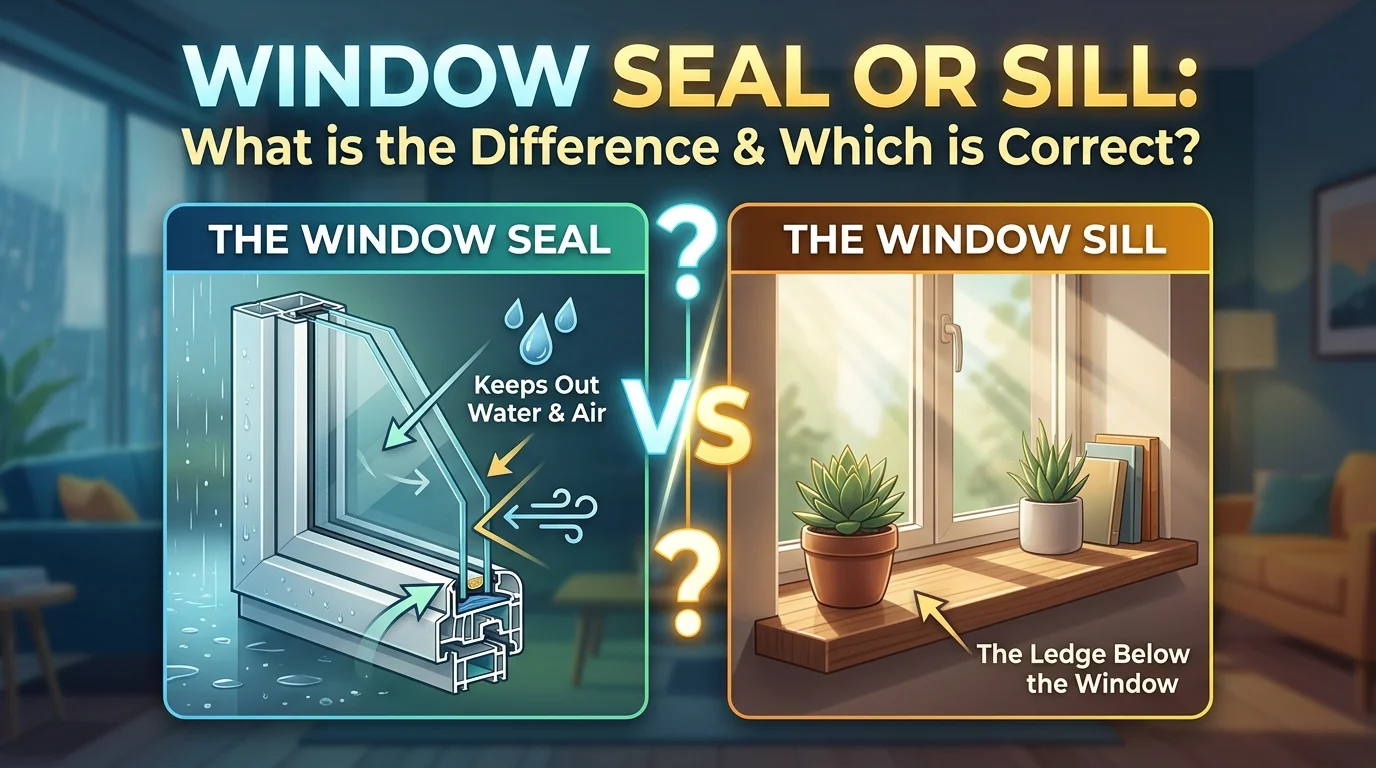

When discussing windows, people often confuse the terms window seal and window sill because they sound similar and are both parts of a window. However, they refer to completely different components with different functions. Understanding the difference can help homeowners, builders, students, and writers use the correct term in the right context.
Comparison Overview
A window is made up of several parts, each serving a specific purpose. The window seal helps prevent air, water, and moisture from entering through gaps around the window. The window sill, on the other hand, is the horizontal ledge located at the bottom of the window frame.
Although both are important for a window’s performance and appearance, they are not interchangeable terms.
| Feature | Window Seal | Window Sill |
| Purpose | Prevents leaks and drafts | Supports and finishes the window structure |
| Location | Around edges and joints of the window | Bottom horizontal part of the window |
| Material | Rubber, silicone, foam, or weatherstripping | Wood, stone, vinyl, metal, or concrete |
| Main Function | Insulation and protection | Structural support and aesthetics |
| Visible? | Often partially hidden | Usually clearly visible |
| Replacement Need | When damaged or leaking | When cracked, rotted, or worn |
Definition of Window Seal
A window seal is a protective barrier that prevents air, moisture, dust, and water from passing through gaps in or around a window. Seals are essential for energy efficiency and weather protection.
Modern windows often contain seals between glass panes as well as around the frame. When a seal fails, condensation, drafts, and increased energy costs may occur.
Purpose of a Window Seal
- Prevents water leaks
- Blocks outside air
- Improves insulation
- Increases energy efficiency
- Reduces noise infiltration
Definition of Window Sill
A window sill is the horizontal surface at the bottom of a window frame. It extends inward or outward and helps support the window structure.
Window sills also direct rainwater away from the wall and can serve decorative purposes inside a home.
Purpose of a Window Sill
- Supports the window frame
- Directs water away from walls
- Enhances appearance
- Provides a small shelf-like surface
- Protects the surrounding structure
Main Differences Between Window Seal and Sill
The biggest difference is that a window seal is designed for protection and insulation, while a window sill is a structural component located at the bottom of the window.
Function
- Window Seal: Stops air and water infiltration.
- Window Sill: Supports the window and sheds water.
Location
- Window Seal: Around edges and joints.
- Window Sill: Bottom section of the window.
Visibility
- Window Seal: Usually hidden or less noticeable.
- Window Sill: Easily visible.
Maintenance
- Window Seal: Requires replacement when leaks occur.
- Window Sill: Requires repair when damaged, rotted, or cracked.
Materials
- Window Seal: Silicone, rubber, foam, weatherstripping.
- Window Sill: Wood, stone, vinyl, aluminum, concrete.
Window Components and Their Importance
Both window seals and sills contribute to the overall performance of a building.
Why Window Seals Matter
Without proper seals, homes can experience:
- Energy loss
- Water damage
- Mold growth
- Increased utility bills
Why Window Sills Matter
Without a properly installed sill, a window may suffer from:
- Water intrusion
- Structural deterioration
- Reduced durability
- Poor appearance
Common Problems Associated with Each
| Window Seal Problems | Window Sill Problems |
| Drafts | Rotting wood |
| Condensation between panes | Cracks |
| Water leaks | Peeling paint |
| Energy loss | Water stains |
| Mold growth | Structural damage |
Grammar Guide
Although these terms belong to construction and home improvement vocabulary, using them correctly in writing and conversation is important.
How Each Term Is Used in Sentences
Window Seal
- The window seal needs replacement.
- A damaged window seal can cause drafts.
- The contractor inspected the seal.
- Moisture entered because the seal failed.
- Energy efficiency depends on a strong seal.
Window Sill
- She placed flowers on the window sill.
- The window sill needs repainting.
- Rainwater runs off the sill.
- The wooden sill was replaced.
- Dust accumulated on the sill.
Common Mistakes Learners Make
- Using “seal” when referring to the bottom ledge.
- Calling the sill a sealing component.
- Assuming both terms mean the same thing.
- Referring to all window parts as seals.
- Ignoring the structural role of the sill.
Simple Rules to Remember
- If it prevents leaks, use seal.
- If it is the bottom ledge, use sill.
- Seals protect.
- Sills support.
- Seals are usually hidden; sills are usually visible.
Quick Tips for Writing and Speaking
- Think of a seal as a barrier.
- Think of a sill as a shelf.
- Use seal when discussing insulation.
- Use sill when discussing structure.
- Check the context before choosing the word.
When to Use Each One
Use Window Seal When
- Talking about insulation.
- Discussing air leaks.
- Referring to weatherproofing.
- Mentioning condensation issues.
- Explaining energy efficiency.
Use Window Sill When
- Talking about window structure.
- Describing a ledge.
- Discussing building design.
- Referring to decorative features.
- Mentioning water drainage.
When NOT to Use Each One
Do Not Use Window Seal When
- Referring to the bottom ledge.
- Discussing decorative window surfaces.
- Talking about structural support.
- Describing a place for plants.
- Referring to visible window shelves.
Do Not Use Window Sill When
- Talking about insulation barriers.
- Discussing weatherstripping.
- Referring to airtight protection.
- Mentioning failed glazing seals.
- Talking about draft prevention.
Which One to Use (Decision Guide)
Ask yourself this simple question:
Are you talking about preventing leaks and improving insulation?
→ Use Window Seal
Are you talking about the horizontal ledge at the bottom of the window?
→ Use Window Sill
Quick Decision Table
| Situation | Correct Term |
| Draft coming through window | Window Seal |
| Water leaking through gaps | Window Seal |
| Condensation between panes | Window Seal |
| Wooden ledge below window | Window Sill |
| Decorating with plants | Window Sill |
| Window support structure | Window Sill |
Real-World Practical Examples
Window Seal Examples
- The technician replaced the damaged window seal to stop drafts.
- A broken window seal increased the home’s heating costs.
- Moisture entered because the seal had failed.
- Energy-efficient windows rely on strong seals.
- The contractor inspected every seal before installation.
Window Sill Examples
- She placed a vase on the window sill.
- The wooden sill needed repainting after years of exposure.
- Rainwater flowed away from the wall thanks to the sill.
- The architect designed a wide window sill for decoration.
- Dust gathered along the sill during renovation.
Self-Assessment (Fill in the Blanks)
- I will use ______ when referring to insulation around a window.
- The correct word is ______ because it prevents drafts.
- I will use ______ when referring to the bottom ledge of a window.
- The correct word is ______ because it supports the frame.
- Moisture entered because the ______ failed.
- She placed books on the ______.
- The contractor repaired the damaged ______ to improve insulation.
- Rainwater drains away using the ______.
- The ______ helps keep outside air from entering.
- The wooden ______ was painted white.
- Condensation appeared because of a failed ______.
- Plants were arranged on the ______.
- The ______ contributes to energy efficiency.
- The cracked ______ required replacement.
- The technician inspected the ______ for leaks.
- The decorative flowers sat on the ______.
- Weatherproofing often involves a strong ______.
- The bottom horizontal part is called the ______.
- Drafts may occur if the ______ becomes damaged.
- A wide ______ can provide extra decorative space.
Answers
- Window Seal
- Window Seal
- Window Sill
- Window Sill
- Window Seal
- Window Sill
- Window Seal
- Window Sill
- Window Seal
- Window Sill
- Window Seal
- Window Sill
- Window Seal
- Window Sill
- Window Seal
- Window Sill
- Window Seal
- Window Sill
- Window Seal
- Window Sill
Final Verdict
The difference between window seal and window sill is straightforward once you understand their functions. A window seal is a protective barrier that keeps out air, moisture, and drafts, helping maintain energy efficiency and comfort. A window sill is the horizontal ledge at the bottom of a window that provides support, helps direct water away from the building, and often adds decorative value. While both are important parts of a window system, they serve entirely different purposes. If you are discussing insulation, leaks, or weatherproofing, use window seal. If you are referring to the bottom ledge or structural component of a window, use window sill. Understanding this distinction will help you communicate more accurately in construction, home improvement, writing, and everyday conversations.
Conclusion About Window Seal Or Sill
Understanding the difference between a window seal and a window sill is important for anyone discussing windows, home maintenance, construction, or property improvements. Although the two terms are often confused, they refer to completely different parts of a window system. A window seal helps keep air, moisture, and drafts out, improving comfort and energy efficiency. A window sill is the horizontal ledge at the bottom of the window that provides support, helps direct water away, and adds visual appeal. Knowing which term to use can prevent misunderstandings and help you communicate more accurately whether you are speaking with contractors, writing about home improvement, or simply learning about window components. When the topic involves insulation and leak prevention, choose window seal. When referring to the bottom ledge or structural portion of a window, choose window sill. Understanding this distinction makes discussing windows much easier and more precise.
FAQs
What is a window seal?
A window seal is a material or barrier that prevents air, moisture, dust, and water from entering through gaps around a window. It plays a key role in insulation, weather protection, and energy efficiency. When a seal becomes damaged, drafts and condensation can occur.
What is a window sill?
A window sill is the horizontal section located at the bottom of a window frame. It supports the window structure, helps direct water away from the building, and often serves as a decorative surface inside a home for plants, photos, or other items.
Are window seal and window sill the same thing?
No, they are completely different components. A window seal is designed to create an airtight and watertight barrier, while a window sill is a structural ledge located at the bottom of the window. They serve different functions and should not be used interchangeably.
Why is a window seal important?
A window seal helps maintain indoor comfort by preventing drafts, moisture intrusion, and heat loss. Properly functioning seals improve energy efficiency, reduce utility costs, and help protect the home from water damage and mold growth over time.
Why is a window sill important?
A window sill supports the window frame and helps move rainwater away from the wall. It also protects surrounding building materials from moisture damage and contributes to the overall appearance and durability of the window installation.
How can I tell if a window seal has failed?
Common signs include condensation between glass panes, noticeable drafts, higher energy bills, and moisture around the window. If these issues appear, the seal may no longer be functioning properly and should be inspected by a professional.
Can a damaged window sill be repaired?
Yes, many damaged window sills can be repaired depending on the material and extent of the damage. Minor cracks, paint issues, or surface wear are often fixable, while severe rot or structural deterioration may require replacement.
Which term should I use when talking about window leaks?
If the leak is caused by air or water entering through gaps, you should use the term window seal. Seals are responsible for preventing leaks, whereas the sill refers to the bottom ledge of the window structure.
Can a window sill affect water drainage?
Yes, a properly designed window sill helps channel water away from the window and exterior wall. This reduces the risk of water infiltration, structural damage, and long-term moisture problems around the window area.
Which is more visible, the window seal or the window sill?
The window sill is generally more visible because it forms the bottom ledge of the window. Window seals are often hidden within the frame or around the edges of the window, making them less noticeable during everyday use.
