
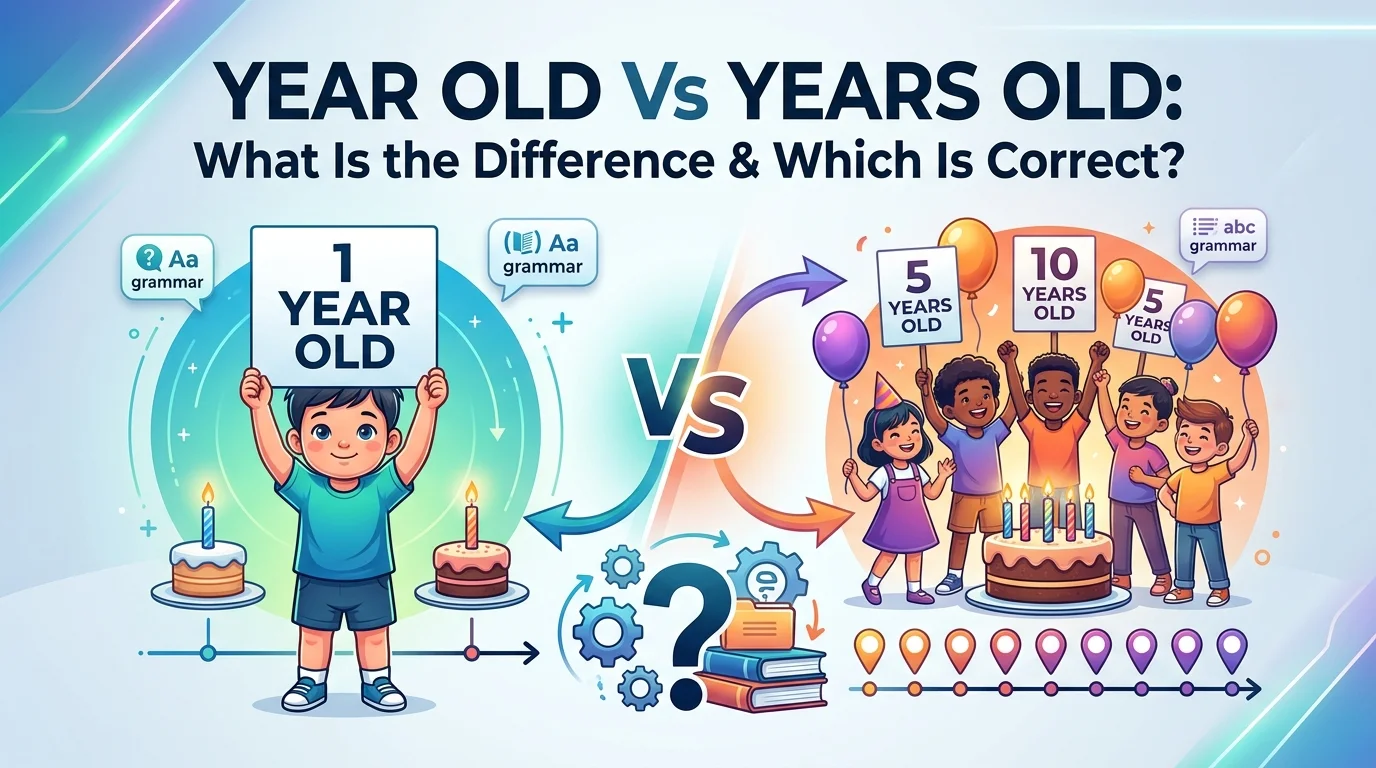

Many English learners get confused between “year old” and “years old” because both phrases relate to age. However, they are used differently depending on grammar and sentence structure. Understanding the difference is important for speaking and writing naturally in English. This guide explains the meanings, grammar rules, examples, and practical usage of both terms in a simple and beginner-friendly way.
Comparison Overview
“Year old” and “years old” both describe age, but they are not interchangeable in every sentence. The difference mainly depends on whether the phrase is used as an adjective before a noun or as part of a sentence after a verb.
For example:
- “A 10-year-old boy” is correct.
- “The boy is 10 years old” is also correct.
Even though both refer to the same age, their grammatical structures are different. Learning where and how to use each one will improve your writing accuracy and spoken English fluency.
Definition of Year Old
“Year old” is usually part of a compound adjective used before a noun. It connects numbers and age into a single descriptive phrase.
Examples:
- A 5-year-old child
- A 20-year-old building
- A 2-year-old cat
In this structure, “year-old” acts like one adjective describing the noun.
Key point:
- It is usually hyphenated when placed before a noun.
Definition of Years Old
“Years old” is a phrase used after a verb, usually after “is,” “are,” “was,” or “were,” to state someone’s or something’s age.
Examples:
- She is 12 years old.
- The house is 50 years old.
- My laptop is 3 years old.
Key point:
- It is not hyphenated.
- It comes after the subject and verb.
Main Differences Between Year Old and Years Old
| Feature | Year Old | Years Old |
| Grammar Role | Compound adjective | Age phrase |
| Position in Sentence | Before a noun | After a verb |
| Hyphen Usage | Hyphenated | No hyphen |
| Example | A 7-year-old girl | The girl is 7 years old |
| Main Function | Describes a noun | States age |
Another important difference is sentence structure.
Correct:
- A 15-year-old student
- The student is 15 years old
Incorrect:
- A 15 years old student
- The student is 15-year-old
Why This Grammar Difference Exists
English often combines words into compound adjectives before nouns. That is why “year-old” becomes singular and hyphenated.
Examples:
- A three-year-old dog
- A ten-year-old car
However, after verbs, normal plural grammar is used.
Examples:
- The dog is three years old.
- The car is ten years old.
This pattern is common in English grammar.
Comparison Table
| Sentence Type | Correct Form |
| Before a noun | 8-year-old boy |
| After a verb | Boy is 8 years old |
| Describing a pet | 2-year-old cat |
| Stating age directly | Cat is 2 years old |
| Describing an object | 50-year-old building |
| Giving age information | Building is 50 years old |
Grammar Guide
How Each Term Is Used in Sentences
Using “Year Old”
Pattern:
- Number + year-old + noun
Examples:
- A 6-year-old student won the prize.
- We adopted a 1-year-old puppy.
- She bought a 100-year-old painting.
Using “Years Old”
Pattern:
- Subject + verb + number + years old
Examples:
- The student is 6 years old.
- The puppy is 1 year old.
- The painting is 100 years old.
Note:
When the number is “1,” “year” becomes singular.
Example:
- The baby is 1 year old.
Common Mistakes Learners Make
Many learners confuse adjective form and sentence form.
Incorrect:
- A 10 years old child
- The child is 10-year-old
Correct:
- A 10-year-old child
- The child is 10 years old
Another mistake is forgetting hyphens.
Incorrect:
- A 5 year old boy
Correct:
- A 5-year-old boy
Simple Rules to Remember
- Use “year-old” before a noun.
- Use “years old” after a verb.
- Use hyphens in compound adjectives.
- Use plural “years” except when the number is one.
Easy memory trick:
- Before noun = hyphen
- After verb = no hyphen
Quick Tips for Writing and Speaking
- Read the sentence position carefully.
- If the age comes before a noun, use “year-old.”
- If the sentence simply states age, use “years old.”
- Always check for hyphens in compound adjectives.
- Practice with daily examples for faster learning.
When to Use Each One
Use “year old” when directly describing a noun.
Examples:
- A 4-year-old child
- A 12-year-old computer
- A 9-year-old horse
Use “years old” when explaining age in a complete sentence.
Examples:
- The child is 4 years old.
- The computer is 12 years old.
- The horse is 9 years old.
When NOT to Use Each One
Do not use “year old” after verbs.
Incorrect:
- She is 10-year-old.
Correct:
- She is 10 years old.
Do not use “years old” before nouns.
Incorrect:
- A 5 years old boy
Correct:
- A 5-year-old boy
Do not forget hyphens in compound adjectives.
Incorrect:
- A 7 year old dog
Correct:
- A 7-year-old dog
Which One to Use (Decision Guide)
Ask yourself one simple question:
Is the phrase before a noun or after a verb?
If it comes before a noun:
- Use “year-old.”
Example:
- A 14-year-old athlete
If it comes after a verb:
- Use “years old.”
Example:
- The athlete is 14 years old.
Quick decision chart:
| Situation | Correct Choice |
| Before noun | Year old |
| After verb | Years old |
| Describing directly | Year old |
| Stating age | Years old |
Real-World Practical Examples
Year Old Examples
- A 7-year-old student solved the puzzle quickly.
- We visited a 200-year-old castle during vacation.
- The family owns a 3-year-old Labrador.
- A 15-year-old athlete won the championship.
- Scientists studied a million-year-old fossil.
Years Old Examples
- The student is 7 years old.
- That castle is 200 years old.
- Their Labrador is 3 years old.
- The athlete is 15 years old.
- The fossil is millions of years old.
Self-Assessment (Fill in the Blanks)
- She adopted a ______ puppy from the shelter.
- The puppy is two ______.
- A ______ building was restored downtown.
- The building is 80 ______.
- My brother is 12 ______.
- A ______ student won the science fair.
- The phone is three ______.
- They bought a ______ car.
- The child is five ______.
- A ______ cat climbed the tree.
- The museum is 150 ______.
- He owns a ______ bicycle.
- The horse is 9 ______.
- We met a ______ artist.
- The artist is 25 ______.
- A ______ bridge collapsed in the storm.
- The bridge was 90 ______.
- She teaches a ______ class.
- The baby is 1 ______.
- We rescued a ______ bird.
Answers
- two-year-old
- years old
- 80-year-old
- years old
- years old
- 12-year-old
- years old
- three-year-old
- years old
- five-year-old
- years old
- 10-year-old
- years old
- 25-year-old
- years old
- 90-year-old
- years old
- 6-year-old
- year old
- one-year-old
Final Verdict
“Year old” and “years old” both describe age, but they follow different grammar rules. Use “year-old” as a hyphenated compound adjective before a noun, such as “a 10-year-old boy.” Use “years old” after a verb when directly stating age, such as “the boy is 10 years old.” Remembering the sentence position makes the choice much easier. With regular practice and attention to hyphen usage, you can confidently use both forms correctly in speaking and writing.
Conclusion About Year Old Vs Years Old
Understanding the difference between “year old” and “years old” can make your English sound much more natural and grammatically correct. Although both expressions relate to age, they are used in different sentence structures. “Year-old” works as a compound adjective before a noun, while “years old” is used after a verb to describe age directly. Once you recognize this simple grammar pattern, choosing the correct form becomes much easier in both writing and conversation. Whether you are describing a child, an animal, a building, or an object, using the right phrase helps improve clarity and professionalism. Small grammar details like hyphen placement and singular versus plural forms can greatly improve your communication skills. With regular practice and real-world examples, you can confidently use both “year old” and “years old” correctly in everyday English without confusion.
FAQs
Is “year old” grammatically correct?
Yes, “year old” is grammatically correct when it is used as part of a compound adjective before a noun. It is usually written with hyphens, such as “a five-year-old boy” or “a ten-year-old building.” This structure helps describe the noun clearly and naturally in English grammar.
When should I use “years old”?
You should use “years old” after a verb when directly stating someone’s or something’s age. For example, “She is eight years old” and “The house is fifty years old” are correct. This form is commonly used in everyday speaking and writing to describe age clearly.
Why is “year-old” hyphenated?
“Year-old” is hyphenated because it functions as a compound adjective before a noun. The hyphens connect the words together so readers understand they describe one idea. Without hyphens, the sentence may look incomplete or grammatically incorrect in formal English writing.
Is it “one year old” or “one years old”?
The correct phrase is “one year old.” When the number is one, “year” stays singular. For example, “The baby is one year old” is correct, while “The baby is one years old” is grammatically incorrect because plural nouns are not used with one.
Can I say “a five years old child”?
No, that structure is incorrect. Before a noun, English uses the singular form with hyphens. The correct sentence is “a five-year-old child.” The phrase acts like a single adjective, which is why “year” remains singular even when the number is more than one.
Do native English speakers use both forms often?
Yes, native English speakers regularly use both “year-old” and “years old” in daily conversation, writing, education, news, and business communication. The choice depends on sentence structure. One form describes a noun, while the other directly states age after a verb.
Can “year-old” describe objects and animals too?
Yes, “year-old” is commonly used for people, animals, buildings, technology, and many other things. Examples include “a three-year-old dog,” “a hundred-year-old bridge,” and “a two-year-old laptop.” It is not limited to describing human age only.
What is the easiest way to remember the difference?
A simple trick is to check the position in the sentence. If the phrase comes before a noun, use “year-old.” If it comes after a verb like “is” or “are,” use “years old.” This quick rule helps avoid most grammar mistakes.
Is “years old” always plural?
No, it becomes singular when the number is one. For example, “The child is one year old” is correct. For any number greater than one, use “years old,” such as “The child is six years old.” The noun changes based on the number used.
Are these expressions important in formal writing?
Yes, using these expressions correctly is important in formal writing because grammar accuracy improves readability and professionalism. Incorrect forms may confuse readers or appear careless. Proper use of “year-old” and “years old” is especially useful in academic, business, and professional communication.
