
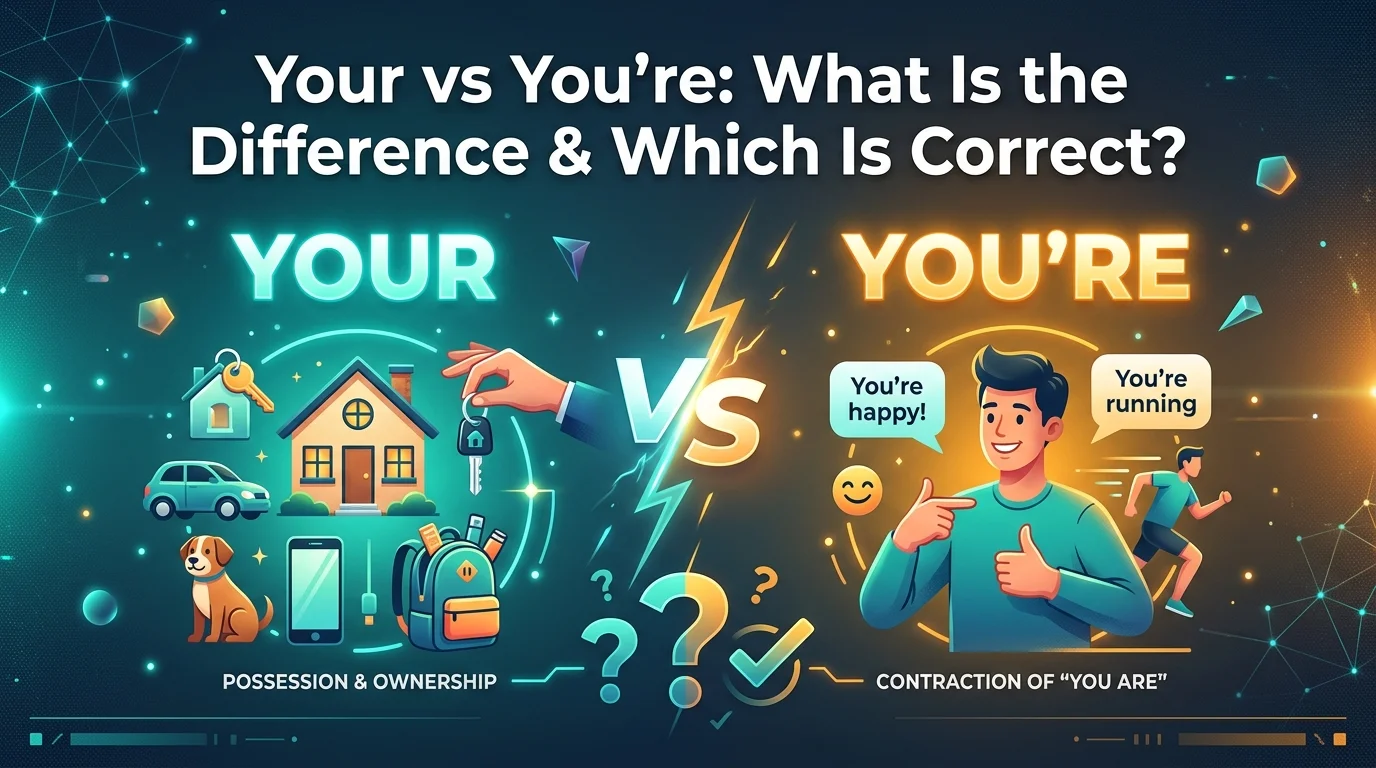

Many English learners and even native speakers sometimes confuse your and you’re because they sound exactly alike. However, these two words have very different meanings and grammatical functions. Understanding the difference between your vs you’re is important for writing correctly, communicating clearly, and avoiding common grammar mistakes in emails, essays, social media posts, and everyday conversations.
Comparison Overview
Your and you’re are commonly confused words in English because they are homophones, meaning they sound the same when spoken. Despite their similar pronunciation, they serve completely different purposes in grammar.
| Term | Part of Speech | Meaning | Example |
| Your | Possessive Determiner | Shows ownership or belonging | Your book is on the table. |
| You’re | Contraction | Short form of “you are” | You’re doing great. |
The key difference is simple: your shows possession, while you’re means you are.
Definition of Your
Your is a possessive determiner used to show that something belongs to or is associated with the person being addressed.
It comes before a noun and indicates ownership, possession, or connection.
Examples:
- Your phone is ringing.
- Is this your backpack?
- Your ideas are excellent.
In each example, your tells us who owns or is connected to the noun.
Definition of You’re
You’re is a contraction of the words you are.
It combines the subject you and the verb are into a shorter form commonly used in speaking and informal writing.
Examples:
- You’re very kind.
- You’re learning English.
- I think you’re correct.
If you can replace you’re with you are and the sentence still makes sense, then you’re is correct.
Main Differences Between Your and You’re
Although these words sound identical, their meanings and grammatical roles are entirely different.
| Feature | Your | You’re |
| Meaning | Indicates possession | Means “you are” |
| Grammar Type | Possessive determiner | Contraction |
| Followed By | Usually a noun | Usually an adjective, verb, or phrase |
| Shows Ownership | Yes | No |
| Can Be Expanded to “You Are” | No | Yes |
Key Difference
Your = belongs to you
Example:
- Your laptop is new.
You’re = you are
Example:
- You’re using a new laptop.
Why People Confuse Your and You’re
The confusion happens because:
- They sound exactly the same.
- Fast typing often causes mistakes.
- Autocorrect does not always catch errors.
- Many writers focus on pronunciation rather than grammar.
Examples of confusion:
❌ Your amazing.
✔ You’re amazing.
❌ I like you’re car.
✔ I like your car.
Comparison Table
| Situation | Correct Word |
| Showing ownership | Your |
| Replacing “you are” | You’re |
| Referring to someone’s belongings | Your |
| Describing someone | You’re |
| Talking about someone’s ideas | Your |
| Saying someone is doing something | You’re |
Grammar Guide
Understanding grammar is the easiest way to distinguish between these words.
How Each Term Is Used in Sentences
Your
Pattern:
Your + Noun
Examples:
- Your jacket looks expensive.
- Your answer is correct.
- Your computer needs updating.
You’re
Pattern:
You’re + Adjective/Verb/Phrase
Examples:
- You’re smart.
- You’re running late.
- You’re going to enjoy this.
Common Mistakes Learners Make
Many learners accidentally interchange the two words.
Incorrect:
- Your welcome.
- I think your right.
- You’re notebook is missing.
Correct:
- You’re welcome.
- I think you’re right.
- Your notebook is missing.
Simple Rules to Remember
- If ownership is involved, use your.
- If you can replace it with you are, use you’re.
- Read the sentence aloud using “you are.”
- If the sentence sounds natural, choose you’re.
- If a noun follows immediately, your is often correct.
Quick Tips for Writing and Speaking
- Check whether the word shows possession.
- Expand you’re into you are as a test.
- Proofread emails and formal documents carefully.
- Practice identifying nouns that follow your.
- Remember that contractions often replace subject + verb combinations.
When to Use Each One
Use Your When
- Showing ownership.
- Referring to someone’s belongings.
- Talking about a person’s ideas or responsibilities.
- Identifying something associated with someone.
Examples:
- Your homework is complete.
- Your dog is friendly.
- Your opinion matters.
Use You’re When
- Meaning “you are.”
- Describing a person.
- Referring to someone’s actions.
- Talking about someone’s current condition.
Examples:
- You’re very patient.
- You’re working hard.
- You’re ready to begin.
When NOT to Use Each One
Do Not Use Your
Incorrect:
- Your funny.
- Your going home.
- Your welcome.
Correct:
- You’re funny.
- You’re going home.
- You’re welcome.
Do Not Use You’re
Incorrect:
- You’re house is beautiful.
- You’re backpack is heavy.
- You’re project looks impressive.
Correct:
- Your house is beautiful.
- Your backpack is heavy.
- Your project looks impressive.
Which One to Use (Decision Guide)
Use this simple process:
- Ask whether the word shows ownership.
- If yes, choose your.
- If not, replace the word with you are.
- If the sentence still works, choose you’re.
Examples:
Sentence: ______ car is parked outside.
Ownership is involved.
✔ Your car is parked outside.
Sentence: ______ very talented.
Replace with “you are.”
✔ You’re very talented.
Real-World Practical Examples
Your Examples
- Education: Your assignment is due tomorrow.
- Daily Life: Your keys are on the kitchen counter.
- Business: Your proposal has been approved.
- Technology: Your password needs updating.
- Writing: Your article was published successfully.
You’re Examples
- Education: You’re improving your grades.
- Daily Life: You’re making dinner tonight.
- Business: You’re leading the next meeting.
- Technology: You’re connected to the network.
- Conversation: You’re my best friend.
Self-Assessment (Fill in the Blanks)
- I will use ______ when referring to something you own.
- The correct word is ______ because it means “you are.”
- I will use ______ when talking about a person’s belongings.
- The correct word is ______ because the sentence can become “you are.”
- I will use ______ before the noun “car.”
- The correct word is ______ because it shows possession.
- I will use ______ when describing someone’s actions.
- The correct word is ______ because it replaces “you are studying.”
- I will use ______ before the noun “opinion.”
- The correct word is ______ because ownership is involved.
- I will use ______ when talking about someone’s project.
- The correct word is ______ because it means “you are welcome.”
- I will use ______ before the noun “friend.”
- The correct word is ______ because the sentence expands to “you are happy.”
- I will use ______ when discussing someone’s responsibility.
- The correct word is ______ because it replaces “you are going.”
- I will use ______ before the noun “phone.”
- The correct word is ______ because possession is shown.
- I will use ______ when the sentence means “you are correct.”
- The correct word is ______ because it can be expanded into “you are.”
Answers
- Your
- You’re
- Your
- You’re
- Your
- Your
- You’re
- You’re
- Your
- Your
- Your
- You’re
- Your
- You’re
- Your
- You’re
- Your
- Your
- You’re
- You’re
Final Verdict
The comparison between your vs you’re comes down to one simple distinction: your shows possession, while you’re is a contraction of you are. Although they sound identical, their meanings and grammatical functions are completely different. Whenever you are unsure, use the substitution test by replacing you’re with you are. If the sentence still makes sense, you’re is the correct choice. If the word is showing ownership or is followed by a noun that belongs to someone, use your. Mastering this small but important grammar rule will make your writing clearer, more professional, and more accurate in academic, business, and everyday communication. With regular practice, choosing between your and you’re becomes quick, natural, and effortless.
Conclusion About Your vs You’re
Understanding the difference between your vs you’re is one of the most important grammar skills for clear and confident English writing. Although these words sound exactly the same, they perform completely different functions in a sentence. Your shows ownership or possession, while you’re is simply a shortened form of you are. Learning to recognize this distinction can help you avoid common mistakes in emails, essays, social media posts, professional documents, and everyday conversations.
A helpful trick is to replace you’re with you are whenever you are unsure. If the sentence still makes sense, you’re is the correct choice. If the sentence refers to something that belongs to someone, your is the word you need. With a little practice and careful proofreading, choosing between these two commonly confused words becomes easy. Mastering your vs you’re will make your communication more accurate, professional, and effective.
FAQs
What is the difference between your and you’re?
The main difference is that your shows possession, while you’re is a contraction of you are. For example, “Your book is interesting” shows ownership, while “You’re reading a book” means “you are reading a book.”
Is your a possessive word?
Yes, your is a possessive determiner. It indicates that something belongs to the person being addressed. It is commonly used before nouns, such as “your car,” “your house,” or “your opinion.”
What does you’re mean?
You’re is the shortened form of you are. It combines a subject and a verb into a contraction. For example, “You’re welcome” means “You are welcome.”
How can I tell whether to use your or you’re?
Try replacing the word with “you are.” If the sentence still makes sense, use you’re. If the sentence is showing ownership or possession, use your instead.
Why do people confuse your and you’re?
People often confuse them because they are homophones, meaning they sound the same when spoken. However, they have different meanings, spellings, and grammatical functions in writing.
Is it correct to say your welcome?
No, “your welcome” is incorrect. The correct phrase is “you’re welcome” because it means “you are welcome.” This is one of the most common grammar mistakes in English.
Can your be used without a noun?
In standard grammar, your is usually followed by a noun because it functions as a possessive determiner. Examples include “your phone,” “your idea,” and “your assignment.”
Is you’re appropriate in formal writing?
Yes, you’re can be used in many forms of writing. However, highly formal or academic writing may prefer the full form “you are” instead of the contraction.
Which word comes before a noun, your or you’re?
Your typically comes before a noun because it shows ownership. For example, “your computer,” “your teacher,” and “your project” are all grammatically correct uses.
What is the easiest rule to remember for your vs you’re?
Remember this simple rule: your = possession, you’re = you are. If you can replace the word with “you are,” use you’re. If you are talking about something someone owns, use your.
