
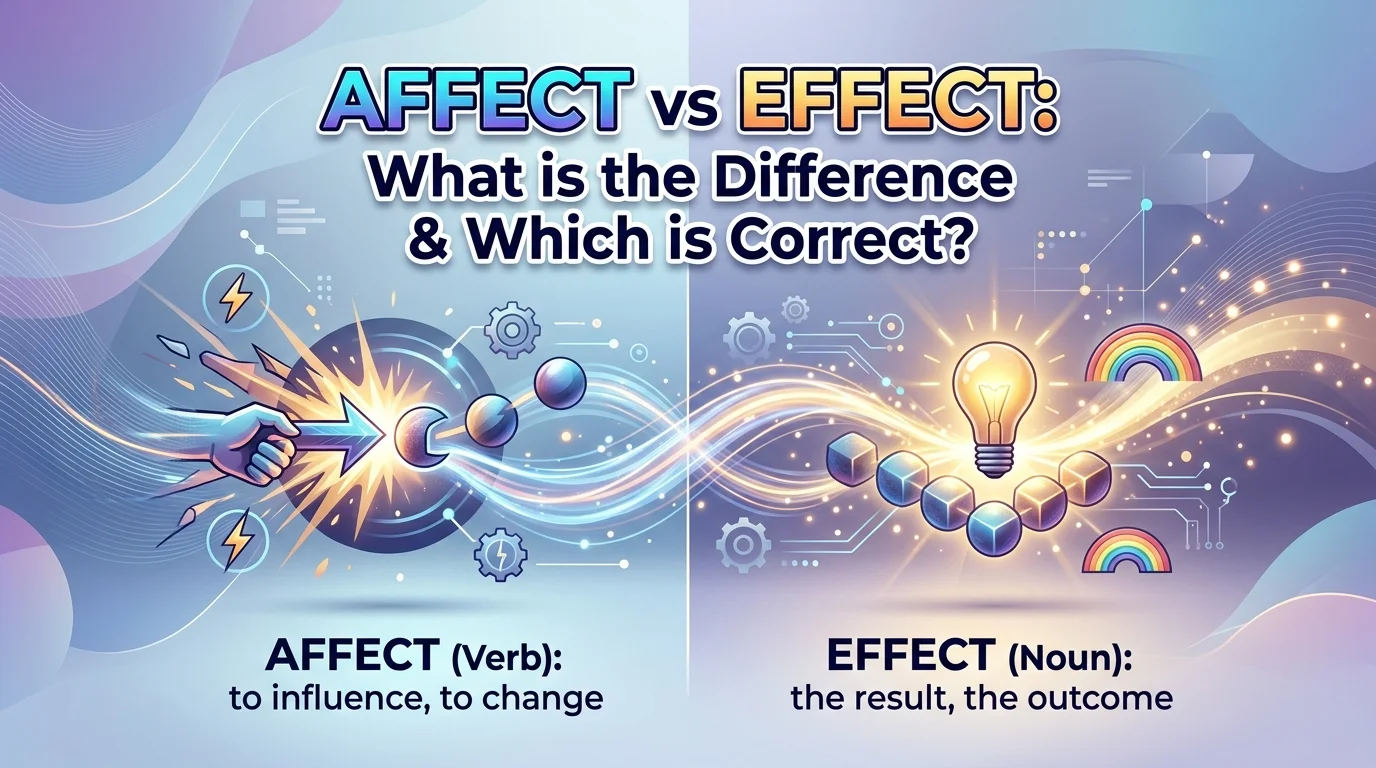

Affect and effect are two of the most commonly confused words in English, often used incorrectly in writing and speech. Understanding the difference between them is important for clear communication, especially in academic, professional, and everyday contexts. This guide breaks down their meanings, usage, and key differences in a simple and practical way.
Comparison Overview
Affect and effect are closely related but serve different grammatical roles. Affect is usually a verb that describes influence or change, while effect is most often a noun that refers to the result of a change. Although they sometimes overlap in advanced usage, their basic functions are distinct and easy to separate once you understand the rules.
Definition of Affect
Affect is mainly used as a verb. It means to influence something or cause a change in it. When one thing impacts another, we use affect to describe that action.
In simple terms, affect is the action of causing change. It shows how something influences another thing in a situation.
Definition of Effect
Effect is mainly used as a noun. It refers to the result or outcome of a change or influence. It tells us what happened because of something else.
In simple terms, effect is the result of an action or cause. It represents the outcome after something has influenced something else.
Main Differences Between Affect and Effect
The main difference between affect and effect lies in their grammatical roles and meanings. Affect is generally a verb showing action, while effect is generally a noun showing result.
Affect describes the process of influencing something. Effect describes what happens as a result of that influence.
For example, heavy rain affects traffic, and the effect of heavy rain is traffic jams.
Key Differences Explained
Affect is active and dynamic, focusing on the action of change. Effect is passive and static, focusing on the result of that change. Affect is something you do, while effect is something you get or observe.
Grammar Guide
Understanding grammar rules helps avoid confusion between these two words.
How each term is used in sentences
Affect is used as a verb in sentences where someone or something influences another thing.
Example patterns:
Subject + affect + object
Effect is used as a noun to describe outcomes or results.
Example patterns:
Cause + produce + effect
Common mistakes learners make
One common mistake is using effect instead of affect when describing influence.
For example:
Incorrect: The weather effects my mood.
Correct: The weather affects my mood.
Another mistake is using affect when referring to a result.
Incorrect: The effect of the medicine is strong.
Correct: The medicine has a strong effect.
Simple rules to remember
Affect starts with “A” and is an Action.
Effect starts with “E” and is an End result.
Quick tips for writing and speaking
If you are describing an action or influence, use affect.
If you are describing a result or outcome, use effect.
When in doubt, check if the word is doing something or describing something that happened.
When to Use Each One
Use affect when you want to describe something that influences or changes something else in real time.
Use effect when you want to describe the result of that influence or change after it has happened.
In writing, affect is more common in verbs and explanations of actions, while effect is common in explanations, reports, and conclusions.
When NOT to Use Each One
Do not use affect when you are referring to a result or outcome. It does not represent a finished consequence.
Do not use effect when you are describing an active influence or action being performed.
Avoid mixing them in formal writing, as it can change the meaning of your sentence completely.
Which One to Use (Decision Guide)
If you are describing something that is doing the influencing, choose affect.
If you are describing what has been produced or what happened because of something, choose effect.
A simple way to decide is:
If it is happening, use affect.
If it has happened as a result, use effect.
Real-World Practical Examples
Affect Examples
- Stress can affect your sleep quality.
- The cold weather affects plant growth.
- Technology affects how people communicate today.
- Pollution affects air quality in cities.
- The teacher’s feedback affected the student’s confidence.
Effect Examples
- The effect of exercise is improved health.
- The new law had a positive effect on society.
- Noise pollution has a negative effect on concentration.
- The effect of sleep deprivation is fatigue.
- The medication showed an immediate effect on the patient.
Self-Assessment (Fill in the Blanks)
- The weather can ______ your mood.
- The ______ of the policy was immediate.
- Stress can ______ concentration levels.
- The ______ of exercise is better health.
- Loud music can ______ hearing.
- The ______ of pollution is environmental damage.
- Diet can ______ energy levels.
- The ______ of technology is rapid communication.
- Smoking can ______ lung health.
- The ______ of sleep is improved memory.
- Poor diet can ______ productivity.
- The ______ of education is knowledge gain.
- Cold weather can ______ crops.
- The ______ of the medicine was noticeable.
- Anxiety can ______ performance.
- The ______ of teamwork is efficiency.
- Climate change can ______ ecosystems.
- The ______ of practice is skill improvement.
- Sugar can ______ energy levels.
- The ______ of exercise on the body is significant.
Answers
- affect
- effect
- affect
- effect
- affect
- effect
- affect
- effect
- affect
- effect
- affect
- effect
- affect
- effect
- affect
- effect
- affect
- effect
- affect
- effect
Final Verdict
Affect and effect may look similar, but they serve very different roles in English grammar. Affect is mainly used to show influence or action, while effect is used to describe results or outcomes. Once you understand this simple difference, choosing the correct word becomes much easier. Remembering that affect is the action and effect is the result will help you use both words confidently in writing and conversation.
Conclusion About Affect vs Effect
Affect and effect are two words that often confuse English learners, but once their roles are clear, using them correctly becomes much easier. Affect is mainly used to describe influence or action, while effect refers to the result or outcome of that influence. This simple distinction helps improve both writing clarity and speaking confidence. Whether you are writing essays, emails, or everyday sentences, remembering this difference will make your English more accurate and natural. With regular practice and attention to context, you can easily avoid common mistakes and use both words correctly in real communication.
FAQs
What is the main difference between affect and effect?
Affect is usually a verb meaning to influence something, while effect is a noun meaning the result of that influence. In simple terms, affect is the action, and effect is the outcome. Understanding this basic rule helps avoid confusion in writing and speaking.
Is affect always a verb?
In most cases, affect is used as a verb to show influence or change. However, in rare psychological contexts, it can also be a noun referring to emotion. Still, for general English usage, you should treat affect mainly as a verb.
Is effect always a noun?
Effect is most commonly used as a noun meaning result or outcome. However, it can sometimes be used as a verb meaning to bring about something, though this usage is less common in everyday English.
How do I remember affect vs effect easily?
A simple trick is to remember that affect starts with “A” for action, and effect starts with “E” for end result. This memory rule helps quickly choose the correct word in most situations.
Can affect and effect be used in the same sentence?
Yes, both words can appear in the same sentence. For example, stress can affect your health, and the effect of stress can be serious. This shows action and result together clearly.
What is a common mistake with affect and effect?
A common mistake is using effect when describing influence. For example, saying “The weather effects my mood” is incorrect. The correct form is “The weather affects my mood.”
When should I use affect in writing?
Use affect when you want to describe something influencing or changing another thing. It is commonly used in discussions about emotions, environment, decisions, and external factors affecting situations.
When should I use effect in writing?
Use effect when you are talking about results or outcomes. It is often used in academic writing, reports, and explanations that describe what happened because of something else.
Are there exceptions to affect and effect rules?
Yes, there are a few exceptions, especially in scientific and psychological contexts. However, in most everyday writing, the standard rule of affect as verb and effect as noun applies.
Why are affect and effect so confusing?
They are confusing because they sound similar and are sometimes used in overlapping contexts. Their meanings are closely related, but grammar rules separate their functions as action and result.
