
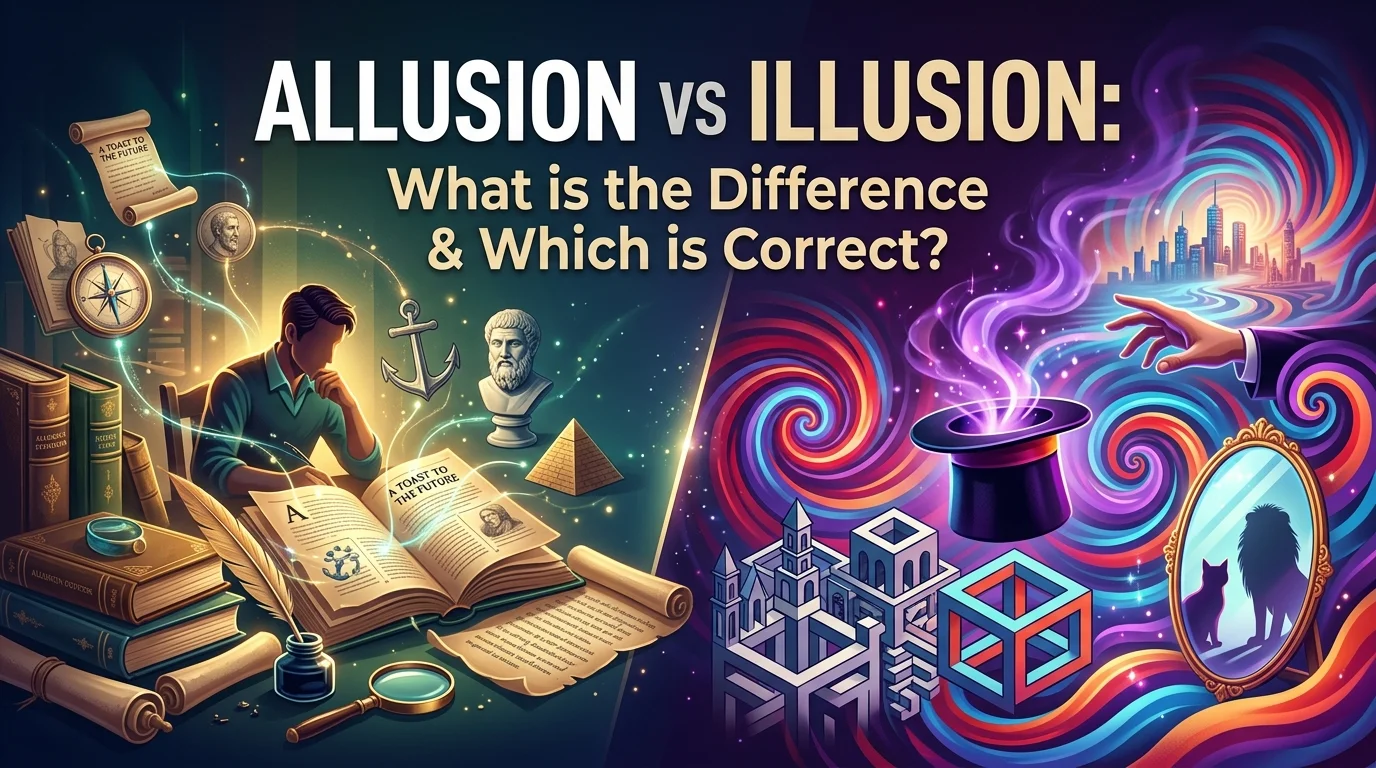

Understanding the difference between allusion and illusion is important for clear communication, especially in writing and literature. These two words often confuse learners because they sound similar but carry completely different meanings. One refers to indirect references in language, while the other refers to false perceptions or deceptive appearances.
Comparison Overview
Allusion and illusion are two English words that are frequently confused due to their similar spelling and pronunciation. However, their meanings are unrelated. An allusion is an indirect reference to something, often used in writing or speech. An illusion is something that tricks the mind or senses and does not reflect reality.
Definition of Allusion
Allusion is an indirect reference to a person, event, book, idea, or place without directly naming it. It is commonly used in literature, speeches, and everyday communication to create deeper meaning or connection for the reader or listener.
Definition of Illusion
Illusion is a false perception or misleading appearance that makes something seem different from reality. It can affect vision, thinking, or understanding and is often used in science, psychology, and magic tricks.
Main Differences Between Allusion and Illusion
The key difference between allusion and illusion lies in meaning and usage. Allusion is a linguistic device used to refer indirectly to something, while illusion is a perceptual phenomenon that deceives the senses.
Grammar Guide
How each term is used in sentences
Allusion is used when referring indirectly to something recognizable. Example: “The poem contains an allusion to mythology.”
Illusion is used when describing something that appears real but is not. Example: “The magician created an illusion of disappearance.”
Common mistakes learners make
Many learners confuse the spelling and use illusion instead of allusion when referring to literature. Another common mistake is using allusion when describing visual tricks or false appearances.
Simple rules to remember
Allusion starts with A, think Association or reference.
Illusion starts with I, think Image or imagination.
Quick tips for writing and speaking
Use allusion in academic writing, literature, and speeches.
Use illusion when describing something deceptive or visually misleading.
When to Use Each One
Use allusion when referring indirectly to something in literature or communication. Use illusion when describing something that deceives the senses or creates a false impression.
When NOT to Use Each One
Do not use allusion when describing physical deception or optical tricks. Do not use illusion when referring to literary references or indirect meaning in text.
Which One to Use (Decision Guide)
If you are talking about a reference or hint in language, use allusion. If you are talking about something that is not real or tricks perception, use illusion.
Real-World Practical Examples
Allusion Examples
- The speech included an allusion to ancient history.
- The novel makes an allusion to classical mythology.
- The article contains an allusion to political events.
- The poet uses an allusion to Shakespeare’s work.
- The teacher explained the allusion in the text.
Illusion Examples
- The magician created an illusion on stage.
- The desert creates an illusion of water.
- Mirrors give an illusion of a bigger room.
- The painting creates an illusion of depth.
- The lights produced an illusion of movement.
Self-Assessment (Fill in the Blanks)
- The writer made an ______ to mythology.
- The magician created an ______ on stage.
- The poem contains an ______ to history.
- The mirror gives an ______ of space.
- The speech included a hidden ______.
- Heat waves create an ______ on roads.
- The novel has an ______ to famous events.
- The design produces an ______ of height.
- The essay includes a cultural ______.
- The trick is based on optical ______.
- The story contains an ______ to legends.
- The painting creates an ______ of motion.
- The book uses an ______ to Shakespeare.
- The magician’s act is a visual ______.
- The writer included a subtle ______.
- The lake was just an ______.
- The speech had a historical ______.
- The stage lights created an ______.
- The author used an ______ to myths.
- The desert view is a common ______.
Answers
- allusion
- illusion
- allusion
- illusion
- allusion
- illusion
- allusion
- illusion
- allusion
- illusion
- allusion
- illusion
- allusion
- illusion
- allusion
- illusion
- allusion
- illusion
- allusion
- illusion
Final Verdict
Allusion and illusion are often confused but have completely different meanings. Allusion refers to indirect references in language, while illusion refers to false perceptions or misleading appearances. Understanding this difference helps you use each word correctly in writing and communication with confidence.
Conclusion About Allusion vs Illusion
Allusion and illusion may look and sound almost identical, but their meanings live in completely different worlds. An allusion is a subtle and indirect reference used in language, literature, and speech to add depth or hidden meaning. In contrast, an illusion is a false perception that tricks the mind or senses into seeing something that is not truly there. Understanding this difference helps improve both writing clarity and reading comprehension. When you clearly distinguish between the two, your communication becomes more precise and expressive. Whether you are analyzing a poem or describing a visual trick, choosing the right word ensures your message is accurate and meaningful. Mastering this simple distinction can greatly enhance your confidence in English usage.
FAQs
What is the main difference between allusion and illusion?
Allusion is an indirect reference to something such as a book, event, or idea, while illusion is a false perception that deceives the senses. One is used in language and writing, and the other relates to visual or mental deception, making them completely different in meaning and usage.
Why are allusion and illusion often confused?
They are often confused because they sound very similar and have close spelling patterns. However, their meanings are unrelated. Allusion relates to referencing ideas indirectly, while illusion relates to seeing or believing something that is not real or accurate.
Is allusion used in everyday conversation?
Yes, allusion can appear in everyday conversation, especially when people refer indirectly to movies, books, or famous events. However, it is more common in literature, speeches, and academic writing where deeper meaning or subtle references are used.
Can illusion be real?
An illusion is not truly real; it only appears real to the senses. It is a misinterpretation of what is actually present. For example, a mirage in the desert looks like water but is not actually there.
What is an example of allusion in literature?
An example of allusion is when a writer refers to a character as having “a Midas touch,” indirectly referencing the myth of King Midas. This adds deeper meaning without directly explaining the myth itself.
How is illusion used in science?
In science, illusion is studied in psychology and optics. It explains how the brain can misinterpret sensory information, such as optical illusions that make stationary images appear to move or change shape.
Is allusion a literary device?
Yes, allusion is a common literary device used to create deeper meaning by indirectly referencing well-known people, stories, or events. It helps writers connect with readers through shared knowledge or cultural understanding.
What are common examples of illusion?
Common examples include mirages in deserts, magic tricks, and optical illusions in images. These create false perceptions that make people see or believe something that is not actually present or true.
How can I remember allusion vs illusion easily?
A simple way is to remember that allusion starts with A for association or reference, while illusion starts with I for imagination or image. This helps quickly identify their correct meanings and usage.
Which word is more common in daily use?
Illusion is more commonly used in daily life because it relates to perception, magic, and visual effects. Allusion is mostly used in writing, literature, and formal communication rather than casual conversation.
